
Airbnb Tax Deductions: The 2026 Guide for Short-Term Rental Hosts

“Smart hosting isn’t just about great stays—it’s about turning everyday details into long-term returns.”
Most Airbnb hosts overpay the IRS by thousands every year — not because their accountant is asleep, but because they don't know which expenses the tax code lets them write off. If you took bookings in 2025, the gap between a sloppy return and a strategic one can easily run into five figures.
This guide walks through the Airbnb tax deductions every short-term rental owner should be claiming in 2026, plus the depreciation moves and local-tax pitfalls that quietly erode host profits.
The 2026 Airbnb Tax Cheat Sheet
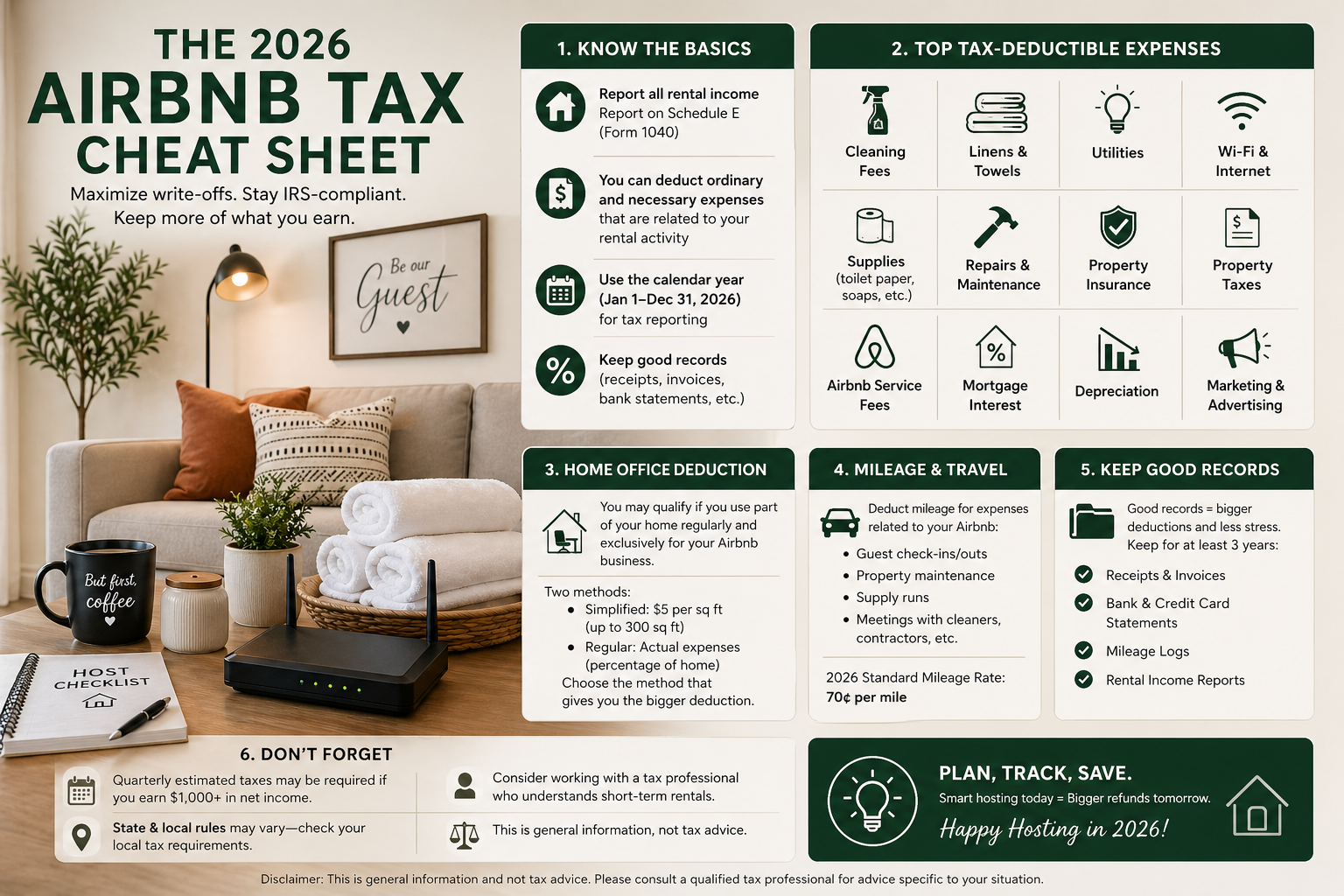
“Disclaimer: This content is for general informational purposes only and should not be considered tax advice. Tax laws may change, and individual situations vary—please consult a qualified tax professional for guidance specific to your circumstances.”
The IRS lets you deduct any "ordinary and necessary" expense tied to the rental — mortgage interest, insurance, cleaning, supplies, management fees, even your travel to the property.
Cleaning fees you charge guests count as taxable income, but the cost of cleaning, laundry, and supplies is fully deductible.
If your average guest stay is 7 days or less, the IRS can treat your rental as non-residential — opening the door to faster depreciation and the 20% Qualified Business Income (QBI) deduction.
Cost segregation can pull tens of thousands of depreciation into year one, even with bonus depreciation reduced.
Austin hosts pay 11% city + 6% state lodging taxes and need a two-year operator's license; non-compliance fines hit $500/day.
What Counts as a Deductible Airbnb Expense?
The IRS rule is straightforward: any expense that is "ordinary and necessary" for running your rental is deductible. "Ordinary" means common in the short-term rental business. "Necessary" means helpful, not strictly required.
That single test covers a lot of ground — mortgage interest, property taxes, insurance, utilities, repairs, supplies, professional fees, and platform commissions all qualify. The catch is that you have to track them. The IRS won't dig through your bank statements for you.
The Airbnb Tax Deductions Most Hosts Miss

“Staring at the numbers, hoping they’ll start making sense—but somehow they only raise more questions.”
Mortgage interest and property taxes are the obvious ones. Here are the categories where hosts routinely leave money on the table.
Cleaning Fees and Turnover Costs
Here's a quirk that catches first-year hosts off guard: the cleaning fee you charge guests is taxable income, even though guests think of it as a separate charge. Airbnb reports it on your 1099-K as part of gross rental income.
The good news is that the actual cost of cleaning is fully deductible. If you charge a guest $100 for cleaning and pay your cleaner $90, you report $100 in income and $90 in expense — netting just $10 in taxable profit on that fee.
This applies to all guest-paid fees: cleaning, extra-guest fees, pet fees, and resort fees all flow through as income, and the related costs (laundry, supplies, professional cleaners, restocking) flow through as deductions.
Repairs, Maintenance, and Supplies
Routine repairs are deductible in the year you pay for them. That includes:
Fixing a leaky faucet or running toilet
Servicing the HVAC or replacing a filter
Repainting scuffed walls between guests
Pest control
Replacing a broken appliance with a similar model
Consumables count too: toilet paper, light bulbs, dish soap, batteries, and the welcome basket of coffee, snacks, and toiletries are all deductible operating expenses.
The line between a "repair" and an "improvement" matters. A leaky faucet repair is deductible now. A bathroom remodel is a capital improvement and must be depreciated over multiple years. When in doubt: did the work restore the property to its prior condition (repair) or make it better than before (improvement)?
Utilities and Recurring Services
Hosts forget these constantly. The full list:
Electricity, gas, water, sewer
Internet, cable, streaming subscriptions
Trash and recycling pickup
Landscaping and lawn care
Smart-lock subscriptions, security monitoring, noise sensors
Channel managers, dynamic pricing tools (PriceLabs, Wheelhouse, etc.)
Listing photography and virtual assistants
If you rent the property part-time or use it personally, prorate based on rental-use days versus personal-use days.
Management and Professional Fees
Anyone you pay to help run the rental is deductible:
STR property managers and co-hosts — including their cut of the revenue
Cleaners, handymen, and landscapers
CPAs, bookkeepers, and tax preparers
Attorneys for lease review, evictions, or compliance work
Airbnb and VRBO host service fees — yes, the platform's cut comes off your top-line revenue as a deductible expense
Travel, Marketing, and Home Office
If you drive to your rental to handle a repair, that mileage is deductible at the IRS standard rate. Out-of-state hosts can deduct flights, lodging, and 50% of meals on legitimate business trips — but the IRS scrutinizes "business travel" that conveniently looks like vacation, so document the work you did.
Marketing costs (paid ads, professional photos, listing-site subscriptions) are fully deductible. And if you have a dedicated space at home for managing the rental — a room used exclusively for that purpose — the home-office deduction can carve out a portion of your home utilities and depreciation.
Depreciation: The Biggest Deduction Most Hosts Underuse

“The deduction hiding in plain sight—quietly building wealth while most hosts overlook it.”
For most hosts, depreciation is the single largest deduction on the return — and the one most likely to be left on the table or done poorly.
The 27.5-Year Rule
The IRS lets you depreciate the building (not the land) over 27.5 years. On a $300,000 structure, that's roughly $10,900 per year in deductions, every year, automatically — without spending another dollar.
If you bought the property years ago and aren't already taking depreciation, you may be able to catch up via Form 3115. Talk to a CPA before filing.
The 7-Day Rule (and Why It Matters in 2026)
Here's the move sophisticated STR hosts use: if your average guest stay is 7 days or less, the IRS treats your property as commercial/non-residential rather than residential rental real estate. Two big benefits flow from that classification:
Faster depreciation — components of the property can be placed on 5-, 7-, or 15-year schedules instead of 27.5 years.
Possible non-passive treatment — if you also "materially participate" in the rental, losses can offset your W-2 or business income, not just rental income. This is sometimes called the "STR loophole."
Track average stay length carefully. One long booking can blow your average past 7 days and torch the strategy for the year.
Cost Segregation in Plain English
A cost segregation study is an engineering analysis that breaks your property into its components and assigns each one its proper depreciation life:
Carpet, appliances, and furniture → 5 years
Cabinetry, fixtures, and decorative elements → 7 years
Driveways, fencing, and landscaping → 15 years
The building itself → 27.5 (or 39) years
Instead of writing off everything over 27.5 years, you front-load deductions into the first few years of ownership.
Worked example: Imagine a $500,000 STR property (excluding land). Standard depreciation gives you about $18,000/year. A cost segregation study might reclassify $100,000 of that into 5- and 15-year assets — letting you deduct $40,000–$60,000 in year one instead of $18,000. [VERIFY: figure depends on 2026 bonus depreciation rate; ask author to confirm with their CPA partner.]
The trade-off: when you sell, depreciation gets recaptured. Coordinate with your tax advisor before commissioning a study (typical cost: $3,000–$8,000).
The QBI Deduction (Section 199A)
If your STR activity rises to the level of a trade or business, up to 20% of your net rental income may be deductible under Section 199A. The IRS has clarified that hosts who actively manage operations and meet certain participation thresholds can qualify.
This isn't automatic. You generally need to:
Maintain separate books for the rental
Spend 250+ hours per year on rental services (collectively, including contractors)
Keep contemporaneous records of your time
Done right, QBI alone can shave 20% off your federal tax bill on rental profits.
Special Considerations for Austin, TX Hosts

“Every decision is a balance—what you give up versus what you gain.”
If you operate in Austin, the local rules deserve their own paragraph.
Austin charges an 11% city occupancy tax (9% Hotel Occupancy Tax + 2% venue tax) on top of Texas's 6% state lodging tax. As of April 2025, Airbnb, VRBO, and other major platforms collect and remit these on your behalf — but you still need to maintain a city HOT account and file quarterly reports.
Austin also requires a two-year STR operator's license, and operating without one can trigger fines up to $500 per day. The city has been actively enforcing this since the 2024 ordinance update.
The license fee, permit costs, and any compliance-related expenses are deductible business expenses. The lodging taxes themselves pass through from guest to government — they're not your income and not your deduction.
How to Reduce Your Airbnb Taxable Income (Action Steps)
Knowing the deductions is half the battle. Here's how to actually capture them:
1. Separate your finances on day one. Open a dedicated bank account and credit card for the rental. Mixing personal and rental expenses is the fastest way to lose deductions in an audit.
2. Use bookkeeping software, not a shoebox. Stessa (free, built for landlords), Hostfully, or QuickBooks all work. Reconcile monthly against your Airbnb and VRBO 1099-Ks.
3. Track rental days vs. personal-use days. This determines what percentage of mixed-use expenses you can deduct, and it gates the 7-day depreciation strategy. A simple spreadsheet works.
4. Hire a CPA who specializes in STRs. A general tax preparer will miss STR-specific moves like cost segregation, QBI, and material participation rules. Search "Airbnb tax accountant near me" and screen for rental-property experience specifically.
5. Time major work strategically. Big improvements get capitalized and depreciated; smaller repairs get deducted now. Sometimes splitting a project into discrete repairs is legitimately advantageous — your CPA can advise.
6. Document everything contemporaneously. Mileage logs, time logs for material participation, receipts, photos of completed work. The IRS rewards good records and punishes reconstructed ones.
Working with an STR-Focused Manager

“Partner with someone who understands the details—so you can focus on the returns.”
Most of the deductions above only count if you actually paid for the service. That's where a dedicated short-term rental manager earns their keep — not just operationally, but on your tax return.
Every fee an STR manager coordinates on your behalf — cleaning, linen service, handyman calls, guest welcome supplies, lockbox replacements — is a deductible operating expense. A flat-fee management model (where vendor costs pass through at cost with no markup) means you keep the full revenue but still deduct the expenses, which is the cleanest setup for tax purposes.
At STR Management Co, we run cleaning turnovers with photo inspections, handle 24/7 guest support, manage dynamic pricing, and coordinate compliance for Austin hosts — all under a flat monthly fee. Every line item we touch is documented and deductible.
Your Next Step
The biggest mistake hosts make isn't choosing the wrong deduction — it's failing to track expenses well enough to claim them at all. Start there.
If you're an Austin host (or thinking about expanding into the market) and want help running compliant, profitable short-term rentals without losing your weekends to guest messages and turnover scheduling, book a free consultation with STR Management Co. We'll walk through your current setup and flag the deductions you might be missing.
What's the one Airbnb tax deduction you didn't know about until now? Tell us in the comments — we'll address the most common ones in our next post.
This guide is for general information only and is not tax advice. Consult a qualified CPA familiar with short-term rentals before making tax decisions for your specific situation.
