
Austin STR Regulation Updates and What They Mean for Owners and Hosts

“All your bookings. All your communication. Fully managed—so you can scale effortlessly.”
If you operate a short-term rental in Austin and haven't updated your compliance game plan since 2024, you're running out of runway. Starting July 1, 2026, the city will begin asking platforms like Airbnb and Vrbo to remove unlicensed listings — and those platforms now have legal obligations to comply. That's not a vague threat on a future agenda; the ordinance is already adopted.
This guide breaks down every Austin short-term rental rule change that matters in 2026: licensing, the new platform enforcement layer, hotel occupancy taxes, fines, the 1,000-foot spacing rule, and a compliance checklist you can act on today.
Key Takeaways
Austin now requires a two-year STR operator's license (changed October 2025). No license = no legal listing.
July 1, 2026 is the hard date: platforms must add a license-number field and delist unlicensed properties when the city requests it.
Hotel Occupancy Tax totals 17% (11% city + 6% state). Platforms collect and remit the city portion as of April 2025, but hosts still file quarterly reports.
Ordinance violations carry fines up to $500 per day. Late HOT filings stack additional penalties and 10% annual interest.
The 1,000-foot spacing rule limits how close one operator's multiple STRs can be on single-family sites.
Austin Short-Term Rental Rules 2026: A Quick Timeline

“Let’s build your next milestone together.”
These aren't incremental tweaks. Each milestone changes what you must do to keep listing and earning.
February 2025 — The city reclassified STRs as an accessory use in all residential zoning districts, provided the property holds a valid operating license. This formalized STRs in the zoning code rather than treating them as a gray area.
October 2025 — A broader ordinance update took effect. Licenses shifted to two-year terms. Certificate-of-occupancy and insurance requirements for new applicants and renewals were removed. Tenants gained the ability to operate with written landlord permission. New spacing and density constraints were introduced (more on the 1,000-foot rule below).
July 1, 2026 — Platform-focused enforcement begins. The city will request removal of unlicensed properties from booking platforms, and platforms must have a license-number display field in place.
The takeaway: if your license, tax accounts, and operational systems aren't buttoned up before July, you risk losing listing visibility — and the revenue that comes with it.
Austin Short-Term Rental License Requirements
Every STR operator in Austin must hold a valid operator's license. No exceptions, no grace period once enforcement kicks in.
Here's what you need to know:
License term: Two years from the date of issuance (updated October 2025).
Tax account prerequisite: You must have an active tax payment account through the city's finance portal before a license will be issued. If your property is in the city's full-purpose jurisdiction, this is non-negotiable — the application won't move forward without it.
License and advertising are linked: The ordinance states that you cannot advertise or promote a short-term rental (or allow someone else to) unless the unit is covered by a valid operator's license. This matters because it means a lapsed license doesn't just create a paperwork problem — it makes your active listing a violation.
How to Apply for a Short-Term Rental License in Austin
Austin accepts applications online, in person, or by mail. Partial applications are not processed, so submit a complete packet the first time.
For online applications, the general steps are:
Gather all required documentation (the city's STR page lists current requirements).
Submit through the city's finance portal.
Email a copy of the owner's driver's license or state-issued ID to the city's STR document email address.
The city publishes current fee amounts on its STR page. [LINK SUGGESTION: Link to the City of Austin's official STR licensing page here — anchor text "current STR license fees and application instructions"]
💡Pro tip: Don't wait until your first booking to start. The application process involves coordination — local contact setup, vendor schedules, and making sure your property is guest-ready for inspection. Starting 60–90 days before your target launch date gives you a buffer if anything gets flagged.
Austin STR Ordinance Changes: What Actually Affects Your Business
Rather than list every line of the ordinance, here's what hits revenue and risk:
Removed barriers (good news): Certificate of occupancy and insurance documentation are no longer required for new applications or renewals. This simplifies the paperwork.
Tenant operators now allowed: Tenants can operate an STR with written landlord permission. This opens up hosting to a wider group but also means landlords need to understand their exposure.
Spacing and density constraints (watch out): New caps apply to multifamily and mixed-use sites. For single-family properties, the 1,000-foot rule limits how an individual operator can cluster multiple STRs (covered in detail below).
License numbers in advertising: The ordinance explicitly requires that license numbers appear in all advertising and promotions. This is the foundation of the July 2026 platform enforcement.
Austin Airbnb Host Requirements: Local Contacts and Noise Rules

“Proactive noise control protects your listing, your license, and your reputation.”
Two areas trip up hosts more than any others — and both carry enforcement risk.
Local Contact Responsibilities
Your designated local contact must live within the Austin metro area (as defined by the city) and be reachable to respond within two hours of being notified about an emergency. If a city employee requests it, that contact must also be physically present at the property within two hours.
This isn't a formality. If a noise complaint or emergency escalates and no one responds, the city has grounds for enforcement action.
What this means practically: You need a local contact who is genuinely available — not someone who's "usually around." If you self-manage remotely or travel frequently, this is where a local operations partner or co-host becomes essential.
[LINK SUGGESTION: Anchor text "local operations partner for Austin STR hosts" linking to your co-hosting services page]
Noise and Nuisance Rules
The ordinance defines specific noise standards and time windows. Operators are responsible not only for their own compliance but for ensuring guests comply as well. That means your house rules, guest communication, and response protocols need to account for noise — not just hope for the best.
[VISUAL SUGGESTION: A simple table or graphic showing Austin's quiet hours / noise time windows would make this section more scannable and shareable.]
Austin 1,000-Foot Rule for Short-Term Rentals

“Proven systems. Real results. A portfolio built on performance.”
If you're an investor or portfolio host, this rule shapes your expansion strategy.
For single-family sites, an individual operator can run more than one STR — but only if the properties are at least 1,000 feet apart. The ordinance includes additional detail on how this applies to certain ownership structures (e.g., LLCs or trusts).
Why it matters: If you're eyeing a second or third property in the same neighborhood, measure first. A 1,000-foot radius is roughly three to four residential blocks in many Austin neighborhoods, which means your next STR purchase may need to be in a different pocket of the city.
Austin STR License Number Required on Listing (July 2026 Enforcement)
This is the single biggest operational shift for 2026.
What's changing: Starting July 1, 2026, platforms must require users to include a license number in their STR listing. Platforms must also have a dedicated license-number display field.
The enforcement teeth: When the city sends a delist notice to a platform, that platform must remove the listing within 10 days. The notice must meet certain requirements, but the mechanism is now codified — not discretionary.
What this means for hosts: If your license lapses or you never obtained one, your listing can be pulled with 10 days' notice. That's not a warning — it's removal. The result: missed reservations, calendar gaps, refund obligations, and damaged search ranking once you relist.
What to do now:
Confirm your license is current and note the expiration date.
Add your license number to every listing on every platform — don't wait for the platform to prompt you.
Set a calendar reminder 90 days before expiration to begin renewal.
Austin Hotel Occupancy Tax for Short-Term Rentals
Taxes are baked into Austin's STR compliance framework. They're tied to licensing, and getting them wrong triggers its own penalty track.
The Rates
City of Austin HOT: 11% (9% occupancy tax + 2% venue project tax)
State of Texas hotel occupancy tax: 6% of the room cost
Combined effective rate: 17%
The state tax applies to all paid lodging — not just hotels. Houses, apartments, and condos rented short-term are included.
The 2025 Platform Collection Rule
As of April 1, 2025, platforms that facilitate STR bookings and accept payment must collect and remit the city HOT on behalf of operators.
But here's the part hosts miss: you still have quarterly reporting obligations. Even though the platform collects and remits, Austin requires operators to report how much HOT each platform collected on their behalf. Platforms must also make tax documentation available to hosts at least quarterly.
Skipping the quarterly report because "Airbnb handles it" is a common and costly mistake.
Austin Short-Term Rental Fines and Penalties
The penalty structure has two separate tracks, and they can stack.
Ordinance Violation Penalties
Each day a violation continues counts as a separate offense. Each offense carries a fine of up to $500. Operating without a license for a month could theoretically mean $15,000+ in fines — before any tax penalties.
City HOT Penalties
5% penalty for failing to file or pay by the due date
Additional 5% penalty after 61 days
10% annual interest starting on the 61st day
State HOT Penalties
$50 penalty on each late-filed report
Additional percentage-based penalties depending on how late payment occurs
The compounding effect is real: a missed filing triggers a penalty, which triggers interest, which grows while you're sorting out the original issue. Staying current on filings — even when platforms handle collection — is the cheapest form of risk management.
Austin STR Compliance Checklist
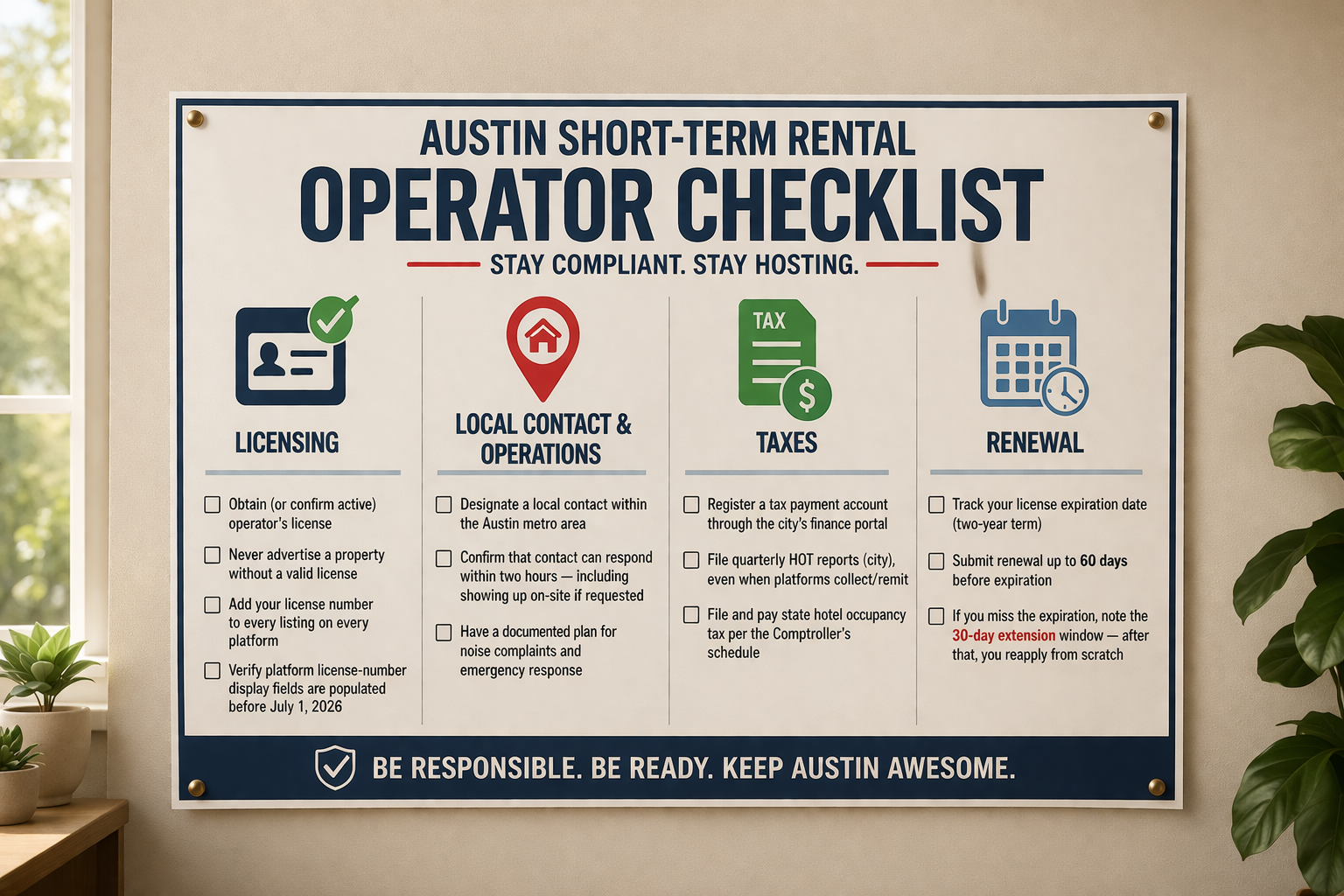
Pin this somewhere you'll actually see it!
Licensing
Obtain (or confirm active) operator's license
Never advertise a property without a valid license
Add your license number to every listing on every platform
Verify platform license-number display fields are populated before July 1, 2026
Local Contact & Operations
Designate a local contact within the Austin metro area
Confirm that contact can respond within two hours — including showing up on-site if requested
Have a documented plan for noise complaints and emergency response
Taxes
Register a tax payment account through the city's finance portal
File quarterly HOT reports (city), even when platforms collect/remit
File and pay state hotel occupancy tax per the Comptroller's schedule
Renewal
Track your license expiration date (two-year term)
Submit renewal up to 60 days before expiration
If you miss the expiration, note the 30-day extension window — after that, you reapply from scratch
Austin STR License Renewal
Licenses are valid for two years from issuance. You can submit a renewal up to 60 days before expiration.
If your license expires, you must reapply for a new one. There's a narrow window: if it's been less than 30 days since expiration, you can request an extension. After 30 days, you're starting over — new application, new fees, and a gap where your listing is technically non-compliant.
Set the reminder now. Renewal should be a scheduled event, not a scramble.
A Note on Cleaning and Turnover Operations
If you've searched for "Austin Airbnb cleaning service," "short-term rental turnover cleaning Austin," or "vacation rental cleaning Austin," you've probably noticed that the real challenge isn't finding a cleaner — it's building a system that delivers hotel-level consistency on every turnover.
Here's what separates an STR that earns repeat five-star reviews from one that generates complaints:
Same-day turnover capability with confirmed scheduling (not last-minute texts).
A property-specific checklist that cleaners follow every time — not a generic template.
Post-clean verification through photos or video, so you have documentation before the next guest walks in.
A response plan for no-shows — because the cleaner who cancels two hours before check-in can tank your guest experience and trigger the kind of review that costs you future bookings.
Cleaning isn't a peripheral service. In a regulatory environment where neighbor complaints and nuisance violations carry fines, consistent property condition is a compliance tool as much as a hospitality one.
What to Do Next
If you're an Austin STR owner or host, here's the move: audit your compliance status this week. Confirm your license, check your HOT filings, verify your license number is displayed on every listing, and make sure your local contact is genuinely available.
The July 1, 2026 deadline isn't a suggestion — it's when the city gains a direct lever to pull your listing off the platforms. The hosts who act now keep earning. The ones who wait risk gaps that are far more expensive than the time it takes to get compliant.
Need help getting your operations and compliance locked down? Talk to our team about flat-fee STR management in Austin. We work with Austin STR owners on a flat monthly fee, no commissions, month-to-month — handling guest support, vendor coordination, cleaning systems, and compliance guidance so you can focus on the investment side.
This guide is for informational purposes and reflects our reading of publicly available City of Austin resources and ordinance language as of April 2026. It is not legal or tax advice. Consult a qualified attorney or CPA for guidance specific to your situation.
