
2026 Direct Booking Guide for Vacation Rental Hosts (Airbnb + STRs)

“Turn bookings into relationships — and guests into repeat revenue.”
If you’re searching for how to set up direct booking for your vacation rental property, this direct booking guide for vacation rentals in 2026 is designed to be the “start here” resource: the website stack, the operational setup, and the marketing engine that actually produces bookings. It’s also written from our day-to-day reality at STR Management Co: direct bookings only work long-term when operations are tight (guest messaging, pricing, turnovers, maintenance, compliance)—not just when the website looks good.
Throughout this post, you’ll see where STR Management Co fits into the direct booking puzzle: we’re the team hosts hire to keep the business running 24/7 with a flat monthly fee (not commission), while you keep your brand, your listings, and your guest relationships.
What direct booking means in 2026

“Be discovered first. Booked direct.”
A direct booking website for short-term rentals is your brand’s owned checkout lane: guests browse your property pages, see real-time availability and pricing, and book directly—without an OTA owning the guest relationship or taking a platform commission. The business result is simple: you reduce dependency while building an asset you control (your website + guest list + repeat-stay engine).
This matters more in 2026 because fee structures and platform policies keep evolving. Airbnb’s public materials describe a “split fee” model (for many hosts: ~3% host fee, plus a guest service fee that can range about 14.1%–16.5%) and a “single fee” model where a host-side service fee (example shown: 15.5%) is deducted from the host’s price to calculate payout. '
On Vrbo, hosts on the pay-per-booking model are shown a breakdown that includes a 5% commission fee plus a 3% payment processing fee; guests may also pay a separate service fee that varies by reservation amount.
And Booking.com states that hosts pay commission and can review their commission details in its partner extranet; many industry sources summarize Booking.com commissions as commonly ranging by market (often described as ~10%–25%, with ~15% frequently cited as an average).
That’s the economics.
The other driver is control: OTAs protect guests and the platform by limiting off-platform behavior. Airbnb explicitly prohibits requesting or receiving payments outside Airbnb for Airbnb reservations (outside specific exceptions) and warns that off-platform payment requests can be a fraud indicator. Airbnb also states it only releases host/guest contact information after a reservation is confirmed.
So when people ask us how to get direct bookings without Airbnb or OTA fees, our answer is: don’t “fight” the platforms—build an independent channel that wins on trust, clarity, and convenience, then use OTAs strategically for discovery while you convert repeat guests and referral traffic into direct. (You do that ethically and compliantly—no policy games.)
This is the essence of a sustainable direct booking strategy for vacation rental hosts: diversify demand sources, own brand + guest list, and run tight operations so the direct experience is actually better than booking on an OTA.
The direct booking foundation STR Management Co handles for you
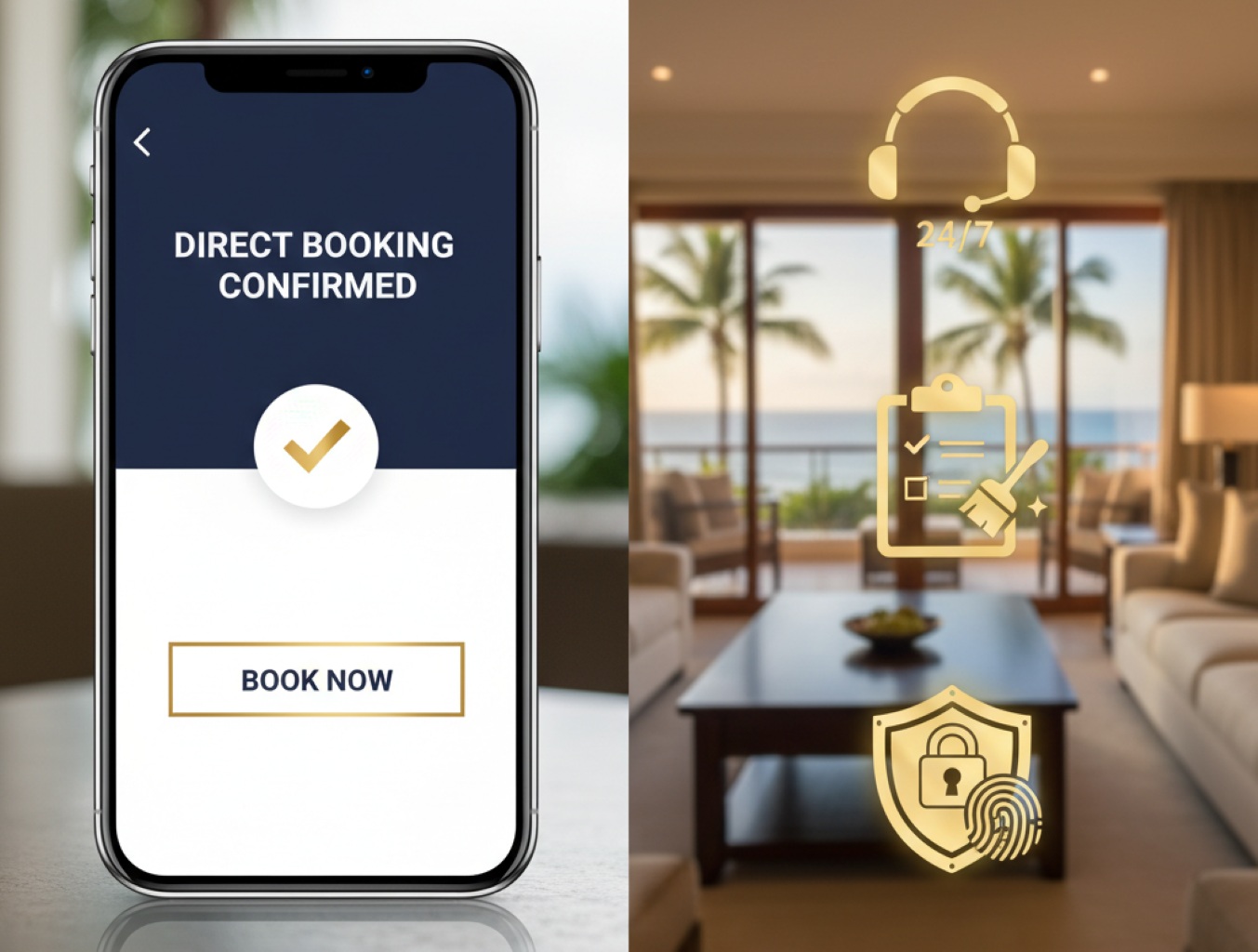
“Your website brings the booking. We deliver the experience.”
Direct booking fails for one predictable reason: hosts treat it like a “website project,” but it’s really an operations + guest experience project.
When a guest books direct, they still expect: rapid answers, professional check-in instructions, a spotless turnover, fast maintenance response, accurate pricing, and frictionless issue resolution. That “expectation gap” is exactly why many hosts either abandon direct booking or turn it into a low-volume side channel.
This is where STR Management Co is built to plug in. Our public service description and FAQs outline a flat monthly fee model ($595/month per property) with no commissions, plus 24/7 guest support and operational coordination (cleaning scheduling and review, repair/maintenance coordination, pricing optimization, listing updates, multi-platform distribution, review management, and regulation/permit guidance). We also describe this as a white-label approach—meaning you keep ownership of your listings, guest reviews, and guest relationships while we operate behind the scenes.
Why this matters specifically for direct booking:
Your direct channel needs 24/7 response coverage. STR Management Co positions “human-driven guest support” as 24/7, with fast response targets.
Your pricing must stay competitive across channels. We describe dynamic pricing and consistent listing updates for search trends as included.
Your turnovers and vendor coordination must be tight. Cleaning scheduling/inspection and repair scheduling are listed as included operations.
Your fraud and dispute exposure changes when you book direct. STR Management Co states it includes “AI guest identity verifications to prevent fraud and chargebacks.”
Bottom line: we’re not “a website builder.” We’re the operating system behind your direct booking channel—so when your website generates leads, you can convert them confidently, protect the property, and deliver a consistent experience (without you being glued to your phone).
Step-by-step setup for your direct booking stack

“Built for effortless, five-star direct bookings.”
If you want an actionable blueprint, here’s the exact order we recommend. This is the section most people mean when they say build a direct booking site for Airbnb hosts—but we’re including the boring parts too, because the boring parts make you money.
Clarify what you’re building
Pick one primary model:
Single-property site (great for one premium home or a strong brandable unit).
Multi-property brand site (best for portfolios, co-hosts, and property managers).
Then pick your build approach:
All-in-one vacation rental software + direct booking site (fastest launch).
Your own website (WordPress/Squarespace/etc.) + embedded booking widget (more customization, more responsibility).
Lock down the non-negotiables for trust, SEO, and conversion
Your direct booking site must meet baseline “trust + usability” expectations or guests will bounce back to OTAs.
HTTPS enabled (SSL/TLS). Google has stated HTTPS is a ranking signal (lightweight, but real), and it also reduces trust friction for checkout.
Fast, mobile-first experience. Google’s documentation explains Core Web Vitals as real-world UX metrics and recommends good CWV for user experience and Search success; Google also explains CWV are used by ranking systems as part of page experience.
Clear pricing and policies. On OTAs, guests are trained to see totals and standardized policies; your direct site must match that clarity, especially if you’re collecting taxes/fees directly.
Connect real-time availability, rates, and policies
The fastest way to create a direct booking experience guests will trust is to use a system that:
Syncs calendars and prevents double bookings (direct + OTAs).
Applies your fees, rules, and minimum stays consistently across channels.
Sends confirmations automatically.
This is why most professional operators anchor direct booking around a PMS/booking engine rather than “a contact form + Venmo.” (That kind of setup doesn’t scale, and it doesn’t build guest confidence.)
Build your legal and operations layer
Direct booking shifts responsibility from “platform enforcement” to “your business enforcement.” Strong operators add:
A short-term rental agreement or rental contract. Industry guidance commonly frames this as a way to clarify rules, responsibilities, cancellations, and dispute handling beyond what platforms standardize.
House rules + damage policy + ID verification flow (where legally permitted). STR Management Co explicitly positions guest identity verification as part of preventing fraud and chargebacks—this becomes more valuable as your direct volume grows.
Privacy + data handling process. Airbnb’s Host Privacy Standards remind hosts they’re responsible for complying with privacy laws and should only use personal info received through the platform as necessary to manage reservations, comply with laws, and deliver host services. Use that as your baseline mindset for direct booking too: collect only what you need, protect it, and be transparent.
Avoid “policy problems” with Airbnb while building direct
A compliant rule of thumb is simple:
For Airbnb reservations, Airbnb prohibits collecting reservation payments outside the platform (except specific exceptions), and it encourages users to treat unexpected off-platform payment requests as potentially fraudulent.
Airbnb also states contact information is only released after a reservation is confirmed.
So: don’t try to “redirect” an in-progress Airbnb chat into a direct payment. Instead, build your direct channel as its own funnel (SEO, referrals, repeat guests who intentionally return) with clean, permission-based marketing.
Best direct booking software options in 2026

“Your direct booking channel is a revenue asset. Build it right.”
This is the buyer-intent section: best direct booking software for Airbnb hosts depends on whether you value speed, customization, or operational depth.
Here are the main “lanes” we see work at scale.
All-in-one PMS with built-in direct booking site
These platforms typically combine: calendar sync, messaging/automation, a booking engine, and a hosted site or site builder.
Lodgify positions itself around creating a vacation rental website to drive commission-free direct bookings and also mentions integrations like Google Vacation Rentals.
Hostfully promotes a “Direct Booking Site” designed to avoid OTA fees, capture direct bookings, and build brand awareness.
Hostaway markets a direct booking website builder integrated with its central calendar and highlights features like templates, analytics connection, and checkout/booking capabilities.
Hospitable promotes launching a direct booking site with payments and automation and provides its own help documentation for creating a direct booking site.
Guesty describes its booking engine as showing real-time availability/rates, applying pricing rules, confirming reservations, and syncing with its calendar/operations; it also documents direct booking options.
When this lane makes sense: you want fast deployment (weeks, not months) and you’d rather optimize marketing + operations than run web development.
WordPress + PMS plugin approach
If you’re serious about SEO control and want a more custom site experience, this lane is common:
OwnerRez describes a WordPress plugin + widgets that let you build a direct booking website integrated with OwnerRez data.
When this lane makes sense: you want deeper customization and you either have a dev resource or you’re willing to manage a more complex web stack.
Direct booking marketplaces
These are not “your website,” but they can be a supplemental direct channel:
Houfy positions itself as a direct booking marketplace with no service fees and emphasizes direct communication and host control.
When this lane makes sense: you want additional fee-light exposure while still prioritizing your own site as the brand hub.
Practical selection rules we use with owners
If you’re deciding quickly, use these filters:
If you manage 1–5 properties and want speed: start with an all-in-one platform with a booking site.
If you manage a growing portfolio and want SEO ownership: use a custom site + embedded engine (or a WordPress/PMS integration).
If you already feel operationally stretched: solve operations first (guest messaging, pricing, cleaners, maintenance), then amplify demand. STR Management Co’s service model is built around taking those daily tasks off your plate while you keep the brand and direct booking upside.
A few direct booking tips for short-term rental property managers that consistently move the needle: keep the booking path simple (search → property → checkout), show transparent totals, match OTA-grade messaging speed, and treat your policies as part of your conversion rate (not just legal fine print).
SEO that drives direct booking traffic

“Own your traffic. Own your bookings.”
This is where most direct booking sites win or die. Design alone doesn’t rank. A reliable strategy aligns with Google Search Central guidance: prioritize content created to benefit people (not content created primarily to manipulate rankings).
When people ask how to increase direct bookings for vacation rentals, we usually translate it into one operational SEO goal:
Become the best answer online for “your property type + your location + your ideal guest.”
Here’s the simple framework we recommend for vacation rental SEO for direct booking traffic.
Build the pages Google can rank
At minimum, your site should have:
A strong homepage that clarifies who you serve and why you’re different.
Individual property pages with rich descriptions, amenities, policies, and high-quality photos.
Location content that matches search intent (neighborhood guides, “things to do,” seasonal/event pages).
If you want to see how we structure event-driven content, our blog shows the approach applied to a major travel moment like the 2026 FIFA World Cup (timely topic selection, clear traveler intent, and operational checklist content).
Win on performance and trust signals
Core Web Vitals and page experience: Google explains CWV measure loading, interactivity, and visual stability, and Google recommends achieving good CWV for success with Search and user experience.
HTTPS: Google has stated HTTPS is a ranking signal (lightweight, but real).
In practice: a fast, secure site reduces “bounce back to Airbnb” behavior because guests feel safer entering payment details and the site doesn’t feel sketchy.
Use vacation rental structured data correctly
Structured data helps search engines understand your listings. Schema.org defines a “VacationRental” type as a kind of lodging business focused on renting single properties for limited time. Google documents “vacation rental” structured data and notes the feature is limited to eligible sites, with additional integration steps required.
This snippet reflects the Schema.org type; eligibility for Google’s vacation rental rich results requires following Google’s vacation rental structured data documentation and integration requirements.
Local SEO fundamentals that still matter
Google’s guidance for local results emphasizes three primary factors (wording varies by page, but the concept is consistent): relevance, distance, and prominence/popularity.
For vacation rentals, that translates to: create location-relevant pages with real traveler value, earn legitimate reviews, and build brand mentions/links that signal you’re a real operator—not a thin affiliate site.
Austin TX and Texas local SEO and compliance notes

“Rank in Austin. Operate in Texas. Book direct without risk.”
Let’s get specific, because local trust is a conversion multiplier.
If you’re targeting direct booking site setup in Austin TX, you need two parallel tracks running at the same time:
Local search demand capture (SEO + content + citations/mentions)
Compliance and tax clarity (so guests trust booking direct
Taxes and licensing are part of your conversion rate
Austin is unusually clear on hotel occupancy tax:
City of Austin states its Hotel Occupancy Tax rate is 11%, comprised of a 9% occupancy tax plus an additional 2% venue project tax.
The Texas Comptroller of Public Accounts states the state hotel occupancy tax rate is 6% of the cost of a room, and that cities/counties may impose additional local hotel taxes.
The Texas Comptroller also notes the combined rates of state + local hotel taxes cannot exceed 17%. (Austin’s 11% local + 6% state totals 17%, aligning with that cap.)
On licensing, Austin’s STR department page states new STR regulations for operators took effect October 1, 2025, including changes like two-year license validity and updates to certain application requirements; it also notes tenants may operate STRs with landlord permission. Separate Austin-area reporting also describes platform-related obligations (like license display and enforcement timing) tied to 2026 implementation windows.
Why this belongs in a direct booking article: when guests try to book vacation rental direct in Austin, they want to know the total cost is legitimate and that the operator is compliant. Clear tax disclosure and license clarity reduce checkout abandonment.
Local SEO for Austin and Texas without gimmicks
For local direct booking vacation rental SEO in Texas, build content that maps to real traveler searches:
“Where to stay in Austin for [event]”
“Pet-friendly stay near [neighborhood/attraction]”
“Family weekend itinerary + where to stay”
Then align it to Google’s local ranking fundamentals (relevance, distance, popularity/prominence).
Operationally, this is where STR Management Co helps: we state we provide listing updates to keep up with search trends and multi-platform distribution, plus regulation/permit guidance—so your direct site, your OTA listings, and your operations stay aligned.
Marketing plan and operating checklist

“A refined strategy deserves flawless execution.”
This is where we put it all together with a simple vacation rental direct booking marketing plan and a practical short-term rental direct booking checklist you can actually use.
The marketing plan that compounds
A sustainable direct booking engine usually has five layers:
Brand and trust layer
Make your site feel as safe as an OTA: secure checkout, transparent policies, professional photos, fast responses, and legitimate reviews. (Direct booking is a trust sale.)
Search capture layer (SEO)
Publish people-first, genuinely helpful content aimed at traveler intent; this aligns with Google’s guidance on helpful, reliable content.
Distribution layer (metasearch/feeds where relevant)
If your platform supports it and you meet eligibility requirements, explore vacation rental structured data and related integrations as documented by Google.
Offer layer
Direct bookings don’t have to be cheaper, but incentives help. Industry playbooks commonly recommend perks like modest discounts (often framed as 5–10% less than OTA pricing), flexible cancellation, or add-ons like early check-in—because you still come out ahead when platform fees are avoided.
Retention layer (repeat and referral engine)
Capturing guest emails and preferences is frequently cited as a major advantage of direct bookings (OTAs often keep customer data more gated), enabling better loyalty campaigns.
If you email past guests, you must respect US email rules. The Federal Trade Commission explains CAN-SPAM compliance basics, including honoring opt-out requests within 10 business days and maintaining functional opt-out mechanisms. Also remember Airbnb’s Host Privacy Standards: only use Airbnb-sourced personal info as needed to manage reservations, comply with laws, and deliver host services (which is why we recommend building your own opt-in list through your direct channel).
Short-term rental direct booking checklist

“Every detail prepared. Every stay elevated.”
Use this as your “minimum viable direct booking system”:
Site and checkout
HTTPS enabled, fast mobile performance, and stable UX aligned with Core Web Vitals guidance.
Real-time availability/pricing sync via your booking engine/PMS (avoid double bookings).
Transparent totals, taxes, fees, and cancellation terms.
Operations
24/7 guest messaging coverage and documented SOPs for check-in/out, issues, and escalations.
Cleaning scheduling + quality verification (photos/checklists).
Maintenance coordination and backup vendor plan.
Risk and compliance
Rental agreement/contract process to clarify responsibilities and reduce disputes.
Guest screening/identity verification where appropriate; STR Management Co states this is part of its service stack.
Tax setup for your jurisdiction (Texas state HOT + local HOT where applicable; Austin’s rates are publicly stated).
If you want this implemented without building an internal team, this is exactly the workload STR Management Co is designed to take over: 24/7 guest support, pricing optimization, vendor coordination, cleaning ops, listing updates, and compliance guidance—while you retain ownership of your brand and direct bookings.
