
Airbnb Co-Host vs Property Manager: Which One Should You Hire?

Co-host or property manager—which one is the right fit for your rental business? The best choice depends on how involved you want to be and the kind of support your property needs.
Key takeaways
A co-host works under your Airbnb listing with permissions you control; a property manager typically runs a broader operation, often under their own systems and brand.
Paid co-hosting commonly runs 10%–25% of booking revenue; traditional full-service management runs 25%–35%, per Evolve's 2026 fee guide and current industry benchmarks.
Fee structure matters more than the headline number. On a $100,000 property, the gap between a 30% manager and a flat-fee service is over $22,000 a year.
Airbnb's own 15.5% host-paid service fee is a separate cost from any co-host or manager fee — model it independently, and reprice for it if you haven't.
The right choice depends on three things: how much responsibility you transfer, how much control you keep, and how the bill scales as your revenue grows.
On a short-term rental earning $100,000 a year, a traditional property manager charging 30% collects $30,000. A co-host at 15% collects $15,000. A flat-fee service collects about $7,000. Same property, same guests, three very different bills.
That is why the Airbnb co-host vs property manager decision matters more than most hosts realize — and why the job title is the least useful part of the comparison. What actually separates the options is the amount of responsibility you transfer, the amount of control you retain, and the way you pay for the help.
This guide breaks down what each role actually does, what each costs at different revenue levels, and how to decide which model fits your property.
Airbnb co-host vs property manager: what actually changes hands
An Airbnb co-host works alongside the listing owner, inside the owner's Airbnb account. Airbnb gives listing owners three permission tiers — full access, calendar-and-messaging access, or calendar-only access — so a co-hosting arrangement can be as narrow or as comprehensive as you want. A full-access co-host can manage messages, the calendar, pricing, listing content, reservations, and even Resolution Center reimbursement requests, according to Airbnb's Help Center.
A short-term rental property manager provides a broader operating system. A full-service manager typically oversees marketing, pricing, channel distribution, guest support, cleaning coordination, maintenance, compliance, owner reporting, and local vendor relationships. Traditional local managers charge 25%–35% of gross booking revenue for that comprehensive, hands-on coverage, per Evolve's 2026 vacation rental management fee guide.
A third model sits between the two. Hybrid, white-label providers deliver property-management-level operations while the owner keeps the listing, reviews, brand, and payouts. STR Management Co operates on this model at a flat monthly fee rather than a percentage of revenue — more on the math below.
The short answer
Hire a co-host when you need selective help and still want to make the important operating decisions yourself.
Hire a traditional property manager when you want to hand over nearly everything, including local field operations, and you accept paying a percentage of revenue for it.
Hire a flat-fee hybrid provider when you want professional systems, 24/7 support, pricing and listing management, and operational oversight — but don't want to surrender your listing or pay more simply because your rental performs well.
What does an Airbnb co-host do?
The honest answer to what does an Airbnb co-host do: whatever the permissions and the service agreement say. Those are two different documents, and confusing them is the most common co-hosting mistake.
Airbnb's platform permissions control what a co-host can do inside Airbnb. They do not guarantee the co-host will clean the property, restock supplies, coordinate contractors, or answer the phone at 2 a.m. Airbnb's own guidance tells owners to set those operational expectations separately, because permissions only govern listing access.

What a co-host cannot do
Adding a co-host does not transfer ownership of your listing. Per Airbnb's Help Center, only the listing owner can set up or edit co-host payouts, and co-hosts cannot view or change the owner's payout method or taxpayer information.
Everything the platform doesn't govern belongs in a written agreement. At minimum, it should define:
Exact operating duties and response-time standards
Airbnb and property-management-system permission levels
Who coordinates cleaning, laundry, restocking, and inspections
Who approves maintenance expenses, and up to what dollar amount
Emergency procedures and escalation paths
Fee calculations and payout timing
Damage-claim responsibilities
Ownership of photography, listing copy, guest data, and reviews
Notice and termination requirements
If a prospective co-host resists putting these in writing, that tells you what you need to know.
Airbnb co-host vs property manager cost

Airbnb co-host vs. property manager cost: compare fees, services, and responsibilities to find the right support for your short-term rental.
The Airbnb co-host vs property manager cost comparison confuses owners because providers use different fee structures and bundle different services. A low headline fee does not mean a low total cost. One company includes guest support but leaves cleaning coordination to you. Another includes inspections but marks up every maintenance invoice.
The comparison that actually matters:
Projected gross revenue − management fees − vendor expenses − platform fees − the value of the work you still do yourself.
Typical Airbnb co-host fees
Professional Airbnb co-host fees commonly take one of these forms: a percentage of booking revenue, a flat monthly amount, a fixed amount per reservation, the cleaning fee, the cleaning fee plus a percentage, an hourly or per-task rate, or a hybrid of a base fee plus add-ons.
Airbnb's payout system supports four of these natively — the cleaning fee, the cleaning fee plus a percentage, a percentage per booking (including or excluding the cleaning fee), or a fixed amount per booking. The listing owner sets the payout, and the co-host confirms it.
There is no Airbnb-mandated rate. Industry guides such as Hospitable's 2026 co-hosting overview place standard paid co-hosting at roughly 10%–20% of booking revenue, climbing to 25% or more when the arrangement includes cleaning coordination, in-person support, and continuous guest communication.
Typical Airbnb property management fees
Traditional Airbnb property management fees run higher because a full-service manager assumes more responsibility and maintains local infrastructure. Evolve's 2026 fee guide places traditional local full-service management at 25%–35% of gross revenue, while lighter hybrid or "half-service" models start around 10%–15%.
Watch for charges stacked on top of the headline percentage: onboarding fees, photography, cleaning and laundry, maintenance callouts and markups, supply procurement, linen programs, smart-home tech, inspections, permit work, software fees, and termination charges. Compare the written contract, not the sales page.
The flat-fee alternative, by the numbers
STR Management Co charges a flat $595 per property per month, plus a one-time $595 onboarding fee, on a month-to-month agreement with no vendor markups.
That works out to $7,140 per year in recurring management cost ($7,735 in year one with onboarding). Here is how that compares to percentage models at different revenue levels. These figures cover management fees only — cleaning, repairs, supplies, taxes, insurance, and platform fees are separate under every model.
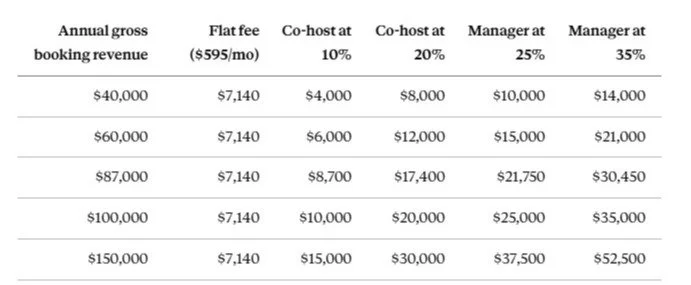
The breakeven points: a $595 monthly flat fee costs less than a 10% co-host once a property earns more than $71,400 a year, less than a 20% co-host above $35,700, less than a 25% manager above $28,560, and less than a 35% manager above roughly $20,400.
A flat fee is not automatically right for every property. A low-revenue or highly seasonal rental may pay less under a percentage model, and the service scope has to match. But the flat-fee advantage compounds as revenue grows: better pricing, stronger reviews, and higher occupancy raise your income without raising your management bill. Under a percentage model, you pay a larger fee precisely because you performed well.
Keep the revenue. Lose the daily workload. STR Management Co provides flat-fee, white-label Airbnb management, co-hosting, cleaning coordination, pricing, and 24/7 guest support while you retain your listings, reviews, and brand. Schedule a free consultation.
Airbnb's platform fee is a separate line item
Whatever you pay a co-host or manager, Airbnb's own service fee comes out of the same revenue — and it changed significantly over the past year.
Airbnb has been retiring its old split-fee model (roughly 3% host + 14%–16% guest) in favor of a single 15.5% host-paid service fee (16% in Brazil and Mexico), calculated on the full booking subtotal including cleaning and other host-set fees, before taxes. Hosts connected through property management or channel-management software were migrated first — U.S. PMS-connected hosts in October 2025, the rest by April 2026. In July 2026, Airbnb announced the final deadlines for all remaining hosts: September 15, 2026 outside the European Economic Area and October 13, 2026 inside it.
The practical takeaway for U.S. hosts: if you use software, you are almost certainly already on the 15.5% structure; if you don't, you will be by mid-September. Either way, reprice so your net payout isn't quietly reduced — and note that dividing your target payout by 0.845 is the correct adjustment, not multiplying your rate by 1.155.
Model these five categories separately, or you will underestimate your true operating cost:
Co-host or manager compensation
Cleaning and turnover expenses
Maintenance and supplies
Taxes and licensing
Airbnb's platform service fee
Is an Airbnb co-host worth it?
The answer to is an Airbnb co-host worth it depends on the bottleneck in your business, and the math is worth doing explicitly.
A co-host earns their fee when they absorb enough repetitive work to improve response speed, protect reviews, and prevent burnout. A co-host is not worth it when duties are vaguely defined or you keep doing most of the work while also paying a meaningful percentage of revenue.
Run the numbers both ways. A co-host charging 20% on an $80,000 property costs $16,000 a year. A limited co-host at $300 a month costs $3,600 — but may leave most of the operation on your plate. The cheaper option only wins when the service level actually matches your needs.
A co-host fits when...
You enjoy hosting but need help with a defined slice of the operation — guest messaging, calendar oversight, check-in assistance, cleaning coordination, or coverage while you travel. It also fits when you have a trusted local person and want to keep pricing, marketing, and financial control yourself.
A traditional property manager fits when...
You want minimal involvement and need a consistent local field presence — common for luxury properties, high-maintenance homes, remote vacation markets, or owners who don't want to approve vendors or talk to guests. The trade-offs are cost and control: higher revenue-based fees, company-controlled systems, and sometimes longer agreements, vendor markups, or restrictions on your access to listing assets. Verify all of these in the contract.
A hybrid flat-fee service fits when...
You want to outsource most daily operations without paying a traditional percentage or giving up your brand. This is the gap STR Management Co was built for — the next section covers how.

What any co-host or manager should actually be doing
Whichever model you choose, evaluate providers against the full reservation lifecycle — not just whether the floors got cleaned. A condensed version of the checklist:
Before the booking. Calendar accuracy across every channel, minimum-stay rules, market-responsive nightly rates, guest screening, and automated messages that reflect current property details. The listing itself should be audited periodically for stale photos, inaccurate amenities, and weak conversion elements.
Before arrival. Confirmed checkout, assigned and verified turnover, ready linens, stocked consumables, closed maintenance tickets, working access codes, accurate arrival instructions, and a visual inspection before the door code goes live.
During the stay. Monitored messages, access troubleshooting, urgent maintenance dispatch, and documentation of complaints or potential damage. Response standards matter: intermittent message-checking may work for a low-volume room rental, not for a multi-bedroom home with same-day turns.
After checkout. Departure confirmation, lost-and-found, damage documentation with time-stamped photos, full turnover, restocking, safety check, review preparation, and Resolution Center action when eligible. This step carries outsized weight: Airbnb's hosting resources identify lack of cleanliness as one of the most common reasons guests rate a stay below five stars, and note that listings charging a cleaning fee get held to an even higher standard.
Compliance. Licensing, taxes, insurance, safety devices, and local occupancy rules. A manager can implement and track these, but legal responsibility stays with the owner.
Austin hosts: compliance is now enforced at the platform level
For hosts in STR Management Co's home market, this item stopped being optional in a practical sense this summer. Austin regulates residences rented for fewer than 30 consecutive days by city ordinance, with licensing handled through Austin Development Services. As of July 1, 2026, new platform regulations took effect: booking platforms must be able to show a valid license number on Austin listings and remove unlicensed properties at the city's request. An unlicensed Austin listing is no longer just a fine risk — it's a delisting risk.
A capable co-host or manager should be tracking your license status, renewal timing, and listing display requirements as part of routine operations.
Where STR Management Co fits
The traditional co-host vs property manager framing assumes you must choose between an individual helper with limited capacity and a full-service company taking a quarter or more of your revenue. STR Management Co is built around a third structure: flat-fee, white-label operations that let owners outsource the daily work while keeping control.
Predictable pricing instead of a revenue penalty. The $595 monthly fee doesn't increase when your nightly rate, occupancy, or annual revenue does. Operating costs stay forecastable, and the upside from strong performance stays with you.
Owner control of listings and reviews. You keep your accounts, platform listings, guest reviews, direct bookings, and brand. The team works behind the scenes rather than replacing your identity with a management-company banner.
Human guest support at all hours. Lock failures, power outages, plumbing issues, and confused arrivals require judgment, not just automation. Support is human-driven, 24/7, with an advertised response time under three minutes.
Cleaning and quality-control coordination. Turnovers are scheduled, confirmed, and reviewed with photo or video documentation, using your preferred cleaners or experienced local vendors — coordinated at cost, with no markup.
Revenue management, not just upkeep. A spotless property can still underperform on bad rates or weak listing copy. Pricing optimization, listing updates, and multi-platform distribution are part of the core service.
Month-to-month flexibility. No long-term contract, and a 30-day trial process under which systems can be reverted if the fit isn't right.
The result functions as a professional co-host, an operational property manager, or both — based on what your property needs.
FAQs

Frequently asked questions, clearly answered—everything you need to know in one place.
What is the main difference between an Airbnb co-host and a property manager?
A co-host works with the owner under the owner's Airbnb listing, with platform permissions the owner selects. A property manager provides a broader business service that may span multiple booking platforms, pricing, local operations, maintenance, and compliance. The terms overlap in practice — a professional co-host can deliver near-full-service management, and a cheap "property manager" may only handle marketing — so compare the written scope, not the title.
What does an Airbnb co-host do for the owner?
Depending on permissions and the private agreement, a co-host may handle guest communication, reservations, pricing, calendar updates, listing changes, check-in support, cleaning coordination, reviews, and eligible damage claims through the Resolution Center.
How much are Airbnb co-host fees?
Industry guides commonly cite 10%–20% of booking revenue for standard paid co-hosting, rising to 25% or more for hands-on arrangements that include cleaning coordination and continuous guest support. Co-hosts may instead charge a flat monthly fee, a per-reservation amount, the cleaning fee, or task-based rates.
How much are Airbnb property management fees?
Traditional local full-service management commonly runs 25%–35% of gross revenue, while lighter hybrid services start around 10%–15%. Flat-fee alternatives exist as well — STR Management Co's operational management package is $595 per property per month with a one-time $595 onboarding fee.
Is an Airbnb co-host worth it for one property?
It can be. Calculate the annual fee against the tasks you'll stop doing. A 20% co-host on an $80,000 property costs $16,000 a year; a $300-per-month limited co-host costs $3,600 but may leave most work with you. The lower price only wins when the service level matches your actual needs.
Should I hire an Airbnb co-host or property manager?
Hire a co-host for targeted support with direct control. Hire a traditional manager for a near-complete handoff with intensive local coverage. Choose a flat-fee hybrid provider when you want professional guest support, pricing, cleaning coordination, and vendor management while keeping your listing and protecting your margins.
Can an Airbnb co-host arrange cleaning?
Yes. Airbnb lists cleaning among the services co-hosts can provide, and a full-access co-host can see the reservation calendar needed to coordinate turnovers. Whether cleaning is personally performed, subcontracted, or merely scheduled must be spelled out in the service agreement.
Does a property manager pay for cleaning?
Usually not out of the management fee. Cleaning is typically billed as a separate property expense or passed to the guest through a cleaning fee. Ask whether the manager adds a markup, requires a specific vendor, or passes invoices through at cost.
Is STR Management Co a co-host or property manager?
Both, functionally. It operates as a white-label short-term rental management and co-hosting partner — property-management-level operating support, delivered under your listing, your reviews, and your brand, at a flat monthly fee. Setup starts with a free consultation, and most properties are onboarded within three to five business days.
Ready to stop managing every message, turnover, and vendor issue yourself? Book a free consultation with STR Management Co and compare your current management costs — percentage fees, markups, and all — against a flat-fee, white-label operating model. Bring last year's revenue number; the math takes five minutes.
