

“The real cost of self-management isn’t just money—it’s your time, attention, and availability.”
The host who "saves" 20% by self-managing is often spending it anyway. It just shows up as unpaid hours at 11 p.m., a cleaner who no-shows on a same-day turnover, and a calendar that never got repriced for a sold-out weekend.
That is the problem with comparing a $0 management fee to a 20% one. The invoice is only part of the cost.
This guide puts real numbers on both sides of the self-manage Airbnb vs property manager decision: what Airbnb property management fees look like in 2026, what self-managing costs once you count your own time, and where the break-even sits for a typical property. We use Austin market data as the reference point, but the math works anywhere.
Self-managing has no invoice, but it does have a cost: your time, software, and the revenue lost to mistakes. At 10 hours a month and $50/hour, that is $6,000 a year of labor on a property that bills you nothing.
Percentage-based managers typically charge 15%–30% of booking revenue, and the bill grows as your property performs better. A $42,000 property pays $8,400 at 20%; a $100,000 property pays $20,000.
Airbnb's platform fee (15.5% for most hosts) is separate from any manager's fee. Model both.
A flat fee of $595/month ($7,140/year) breaks even with a 20% manager at about $35,700 in annual revenue. Above that, every extra booking dollar is yours.
The right question is not "who charges least?" It is "what am I left with after fees, platform costs, and the value of my time?"
What Self-Managing an Airbnb Really Costs
Owners researching how to manage an Airbnb yourself usually start with a simple equation: management fee = $0. That is accurate as far as it goes. It is also incomplete.
The complete equation looks like this:
True self-management cost = platform fees + cleaning + software + supplies + maintenance + compliance + your labor + the cost of mistakes
Some of those lines exist no matter who manages the property. Cleaning, repairs, supplies, insurance, taxes, and Airbnb's fee do not go away when you hire help. So the honest comparison separates property expenses you pay regardless from the cost of management itself. Two lines belong in that second bucket and almost never make it into a self-manager's spreadsheet: your time and your errors.
Your time is an operating expense, not a rounding error
Self-managing means you are the revenue manager, guest-support desk, cleaning coordinator, inspector, maintenance dispatcher, review manager, compliance tracker, and emergency contact. On a quiet month that might be five hours. On a month with a damage claim, an HVAC failure, and a cleaner who quit, it is thirty.
Put a dollar figure on it. At $50 per hour:
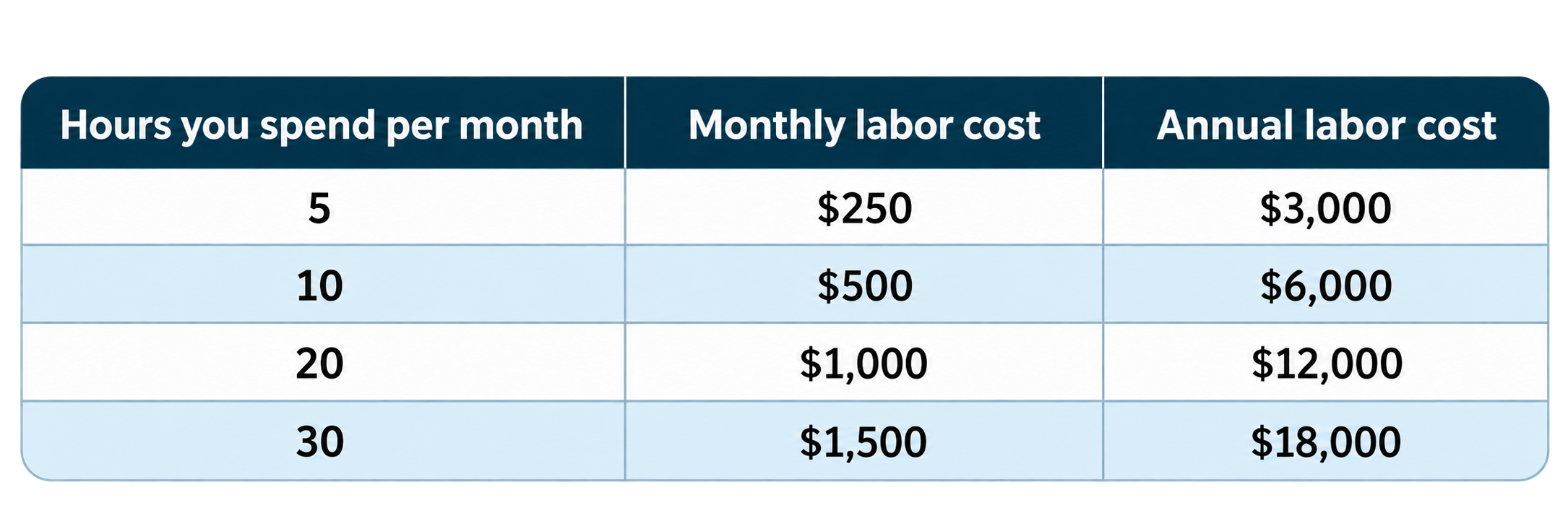
These are illustrative, not industry averages. Swap in your own hourly value and your own hours. The point stands either way: a host spending 20 hours a month on a rental has contributed $12,000 of labor to a business that sent no invoice.
That does not make self-managing wrong. A host who enjoys hosting, lives nearby, has reliable vendors, and runs the property efficiently can rationally keep doing it. But the labor belongs on the comparison sheet.
Mistakes cost more than fees
The second hidden line is harder to quantify but often larger. Common self-management errors and what they typically cost:
Static pricing through a demand spike. If a major event lifts local rates 40% for four nights and your calendar never moved, that is roughly $350 left on the table at a $217 base rate. Do that three or four times a year and you have paid a month of management fees.
Slow response to inquiries. Airbnb's search ranking rewards fast response and penalizes declines and cancellations. A host who answers in four hours instead of four minutes books fewer stays, and never sees the ones that went elsewhere.
A missed or incomplete turnover. One guest arriving to a dirty home costs a refund, a 1-star review, and lower conversion on every future booking that review touches.
A lapsed license. In Austin, that can now mean the listing comes down (more on that below).
None of these show up as a management expense. All of them reduce the income a self-managed property actually produces.
Cleaning is a property cost under every model
Owners sometimes confuse the guest-facing cleaning fee with free money. It is not. Airbnb calculates your payout from the nightly rate plus host-added charges like the cleaning fee, then deducts its service fee from the total. The cleaning fee is part of your booking economics, and the cost of performing the turnover still has to be paid.
In Austin, published turnover rates currently run roughly $75–$275 per clean depending on home size, laundry, linen resets, and restocking. [VERIFY: author confirmed these ranges from Austin cleaning-company price pages in October 2026; re-check the two or three cited companies before publishing and link one as the source.]
Whoever manages your property, that line stays. What changes is who schedules it, who confirms it happened, and who finds a replacement when the cleaner cancels at 10 a.m. on a same-day turnover.
How Much Airbnb Property Managers Charge in 2026
How much do Airbnb property managers charge? There is no single number, but the market clusters into three structures.
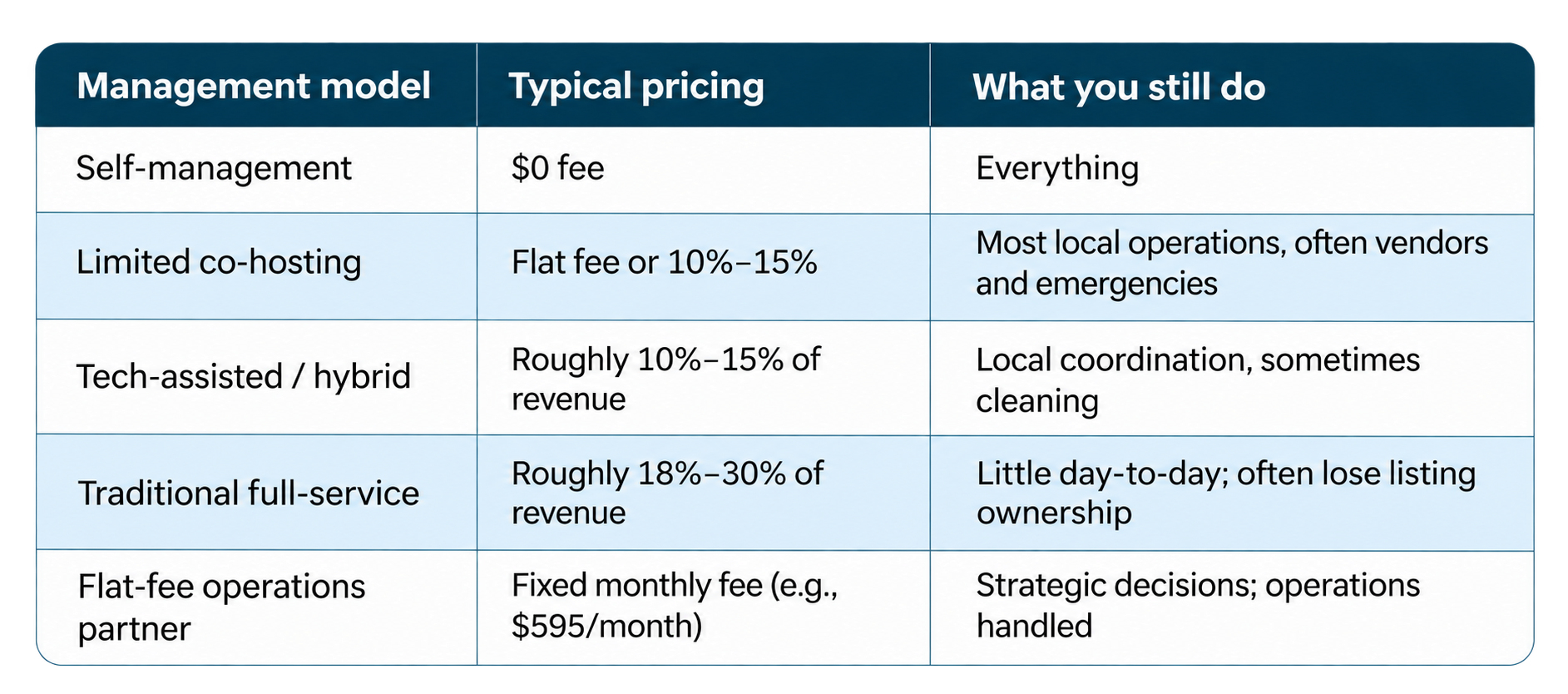
Two things matter more than the headline percentage.
First, what the percentage buys. A 10% manager who leaves you coordinating cleaners, maintenance, and 2 a.m. lockouts is cheaper partly because you are still doing a meaningful share of the job. A 25% manager who handles everything may be the better deal, or may not. You cannot know until you list what is included.
Second, what is billed on top. Onboarding, photography, software, inspections, linen programs, supply runs, emergency callouts, termination fees, and vendor markups all change the all-in cost. A 5%–15% markup on every plumber and cleaner invoice can quietly add thousands a year to a contract that looked lean on paper. Ask for the full fee schedule, not the brochure.
The Airbnb fee is not the management fee
This trips up more owners than anything else in the comparison.
Airbnb now charges most hosts a single service fee of 15.5% of the booking subtotal, deducted from the payout. A small number of hosts fall in a 14%–16% range, and the old split-fee model (where guests paid most of it) was retired in late 2025.
That 15.5% is a platform cost. It has nothing to do with your manager. A host paying a 20% manager is not spending 20% on distribution; they are spending 15.5% to Airbnb plus 20% to the manager, before cleaning, maintenance, supplies, taxes, and insurance.
So model it as:
Platform fees + management compensation + turnover + maintenance + supplies + taxes/licensing + insurance
Any comparison that collapses those into one number will mislead you.
Percentage fees grow with your success
Percentage pricing has one real advantage: when revenue falls, so does the bill. The trade-off is that when revenue rises, the bill rises with it, even though the work of managing a $100,000 property is not three times the work of managing a $30,000 one.
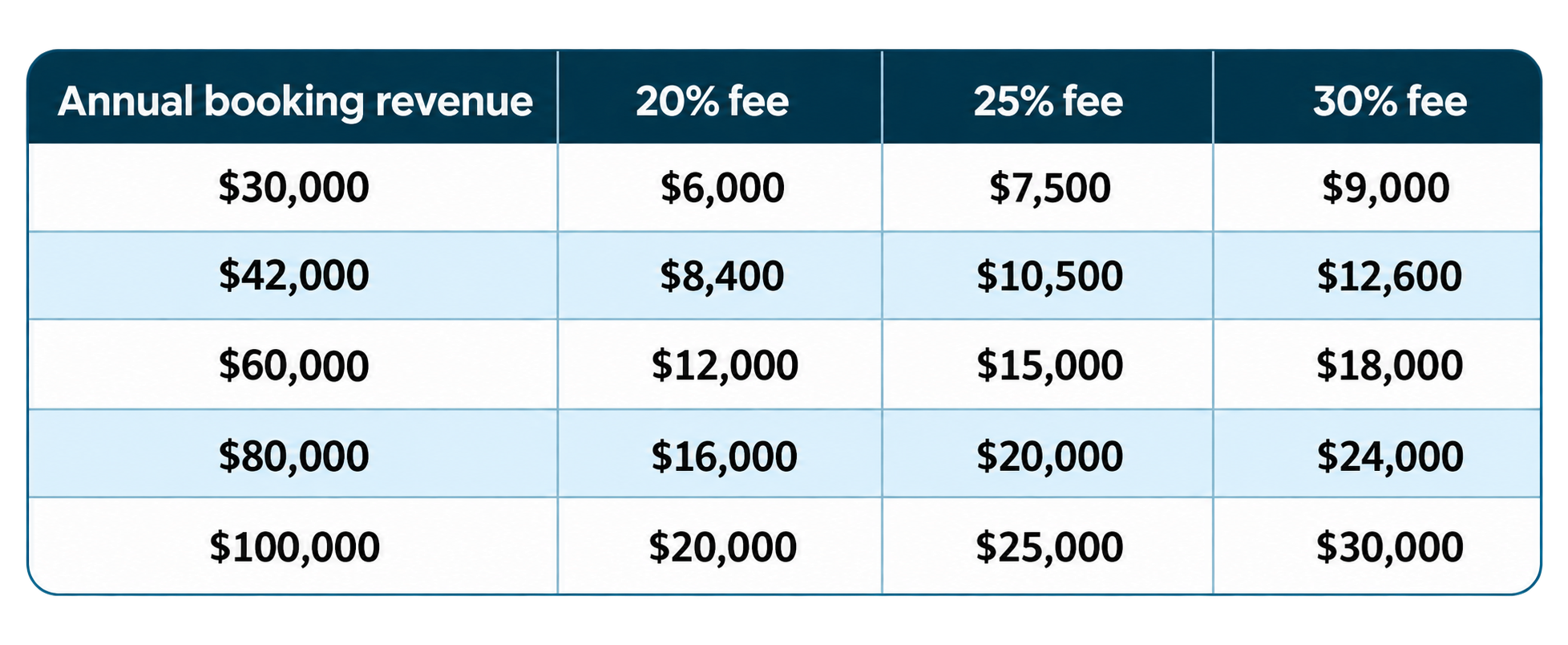
A flat fee behaves differently. At $595 per month, management costs $7,140 a year whether the property books $30,000 or $130,000. (Add a one-time $595 onboarding fee and year one is $7,735.) Cleaning, repairs, supplies, Airbnb fees, taxes, and insurance remain separate under either model.
Self-Manage vs. Property Manager: The Side-by-Side Math
Now put it together. Take an Austin property producing $42,000 a year, which matches AirDNA's current trailing-twelve-month revenue for the average active Austin listing (roughly 14,800 active listings, 59% occupancy, $217 ADR). That is a market-wide average, not a forecast for your home, but it is a fair reference point.
Management cost alone at $42,000
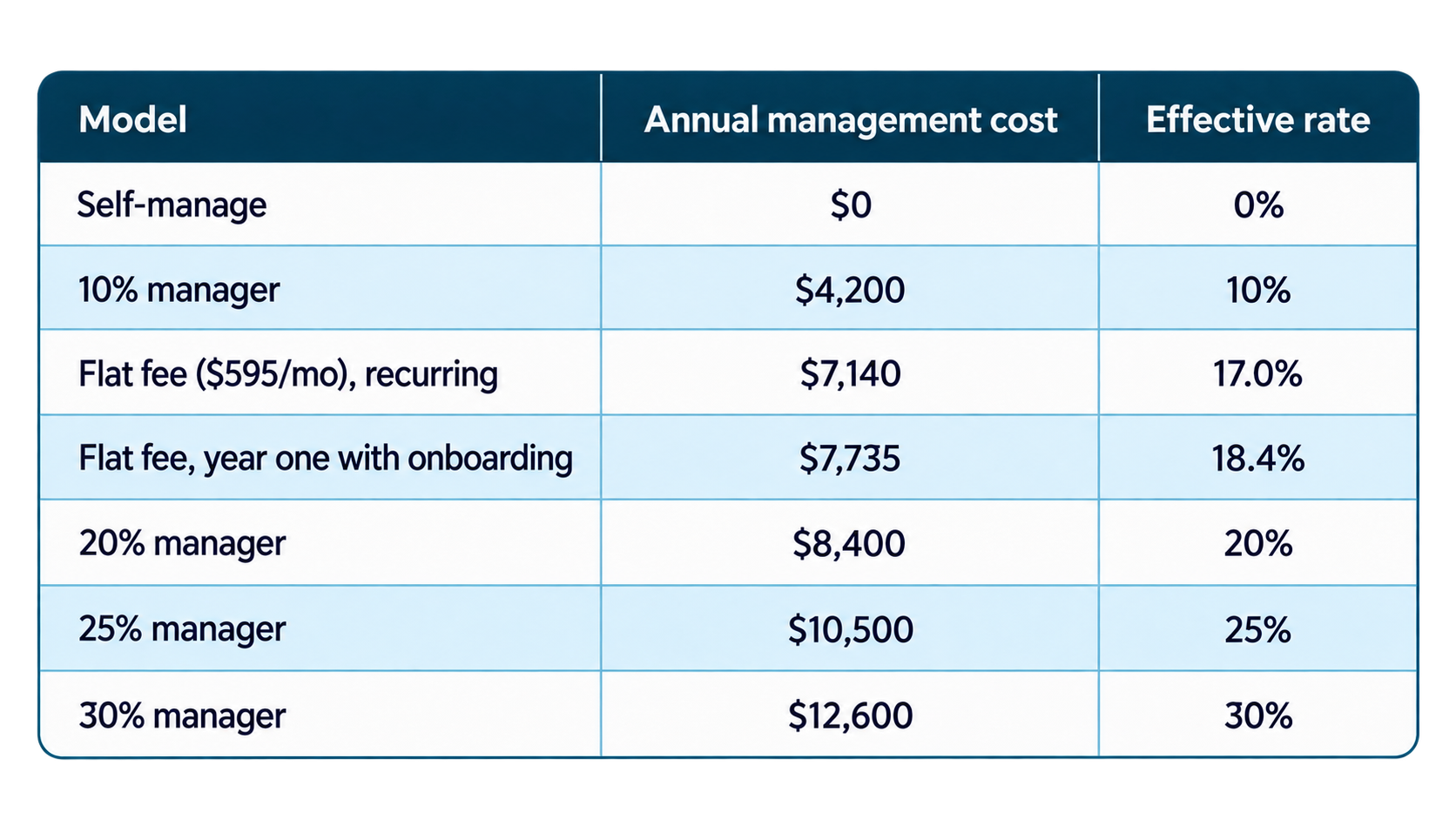
Notice that at this revenue level, a 10% arrangement costs less than the flat fee. Flat pricing is not automatically cheaper. It depends on what the property earns and what the 10% actually covers.
The same comparison at $100,000
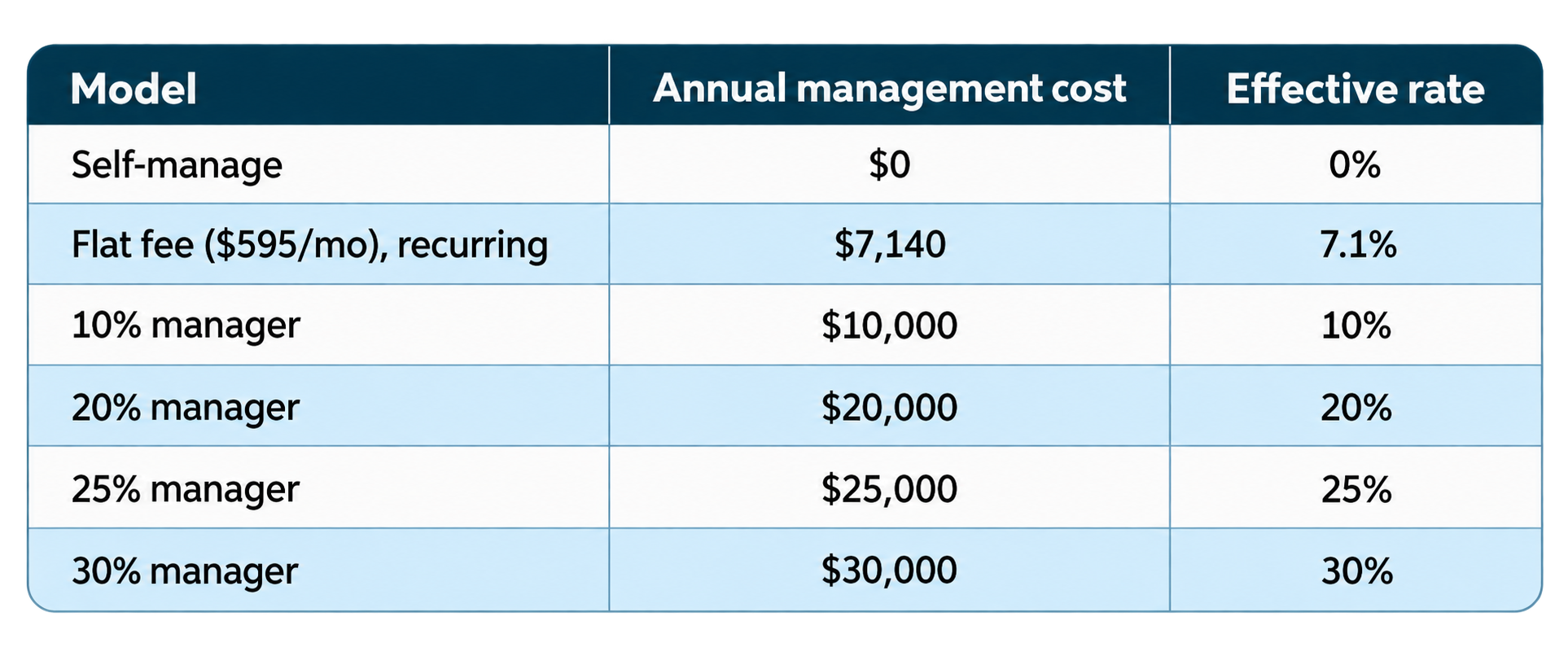
At $100,000, the flat fee saves $12,860 a year against a 20% manager and $22,860 against a 30% manager, on management fees alone.
Where the flat fee breaks even
The $7,140 flat fee equals a percentage fee at these revenue levels:
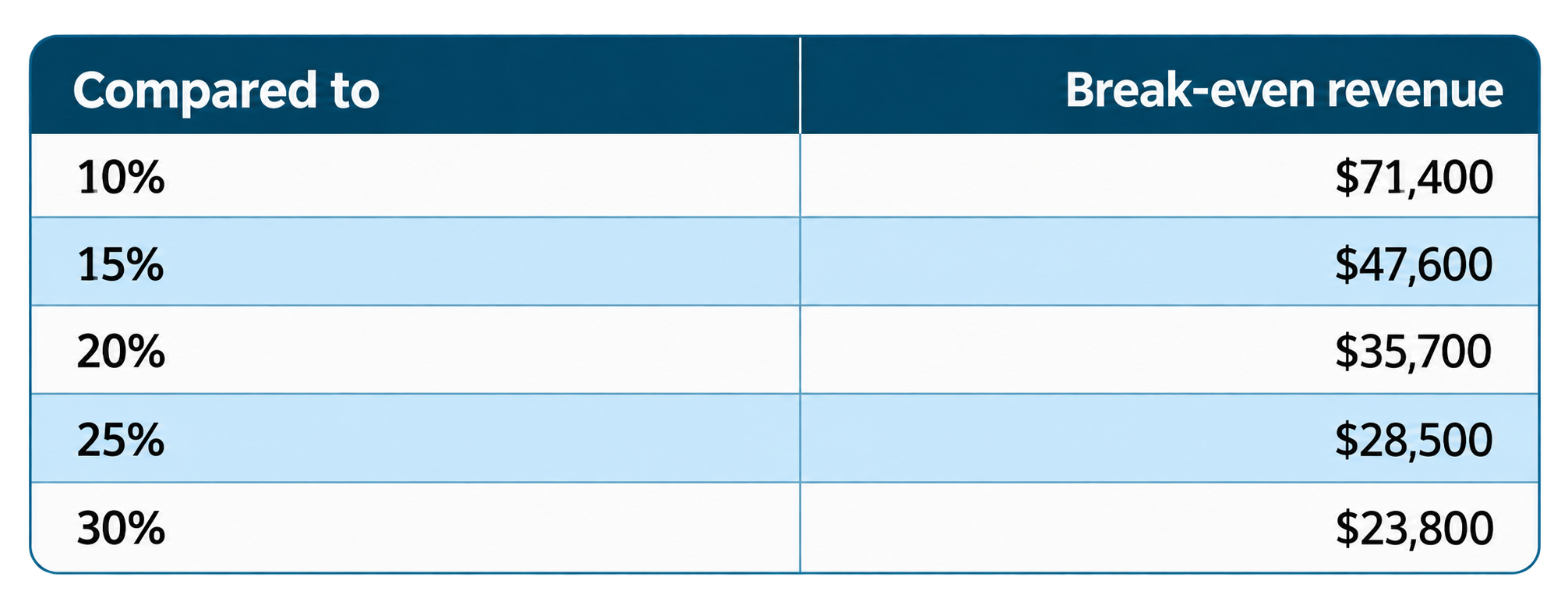
Below the break-even, the percentage manager is cheaper. Above it, the flat fee is. For a property earning more than about $36,000 a year, a flat fee beats a typical 20% full-service contract, and the gap widens with every additional booking.
Fee equivalence is not the whole story. A cheap manager who underprices your calendar, responds slowly, or lets listing quality slide can cost more in lost revenue than they save in fees. A more expensive manager who lifts occupancy and ADR can pay for themselves. Compare net income after everything, not the fee line.
Now add the self-manager's labor
Put the hidden cost back in. Suppose the same $42,000 property takes 10 hours a month to run, and you value your time at $50 an hour.
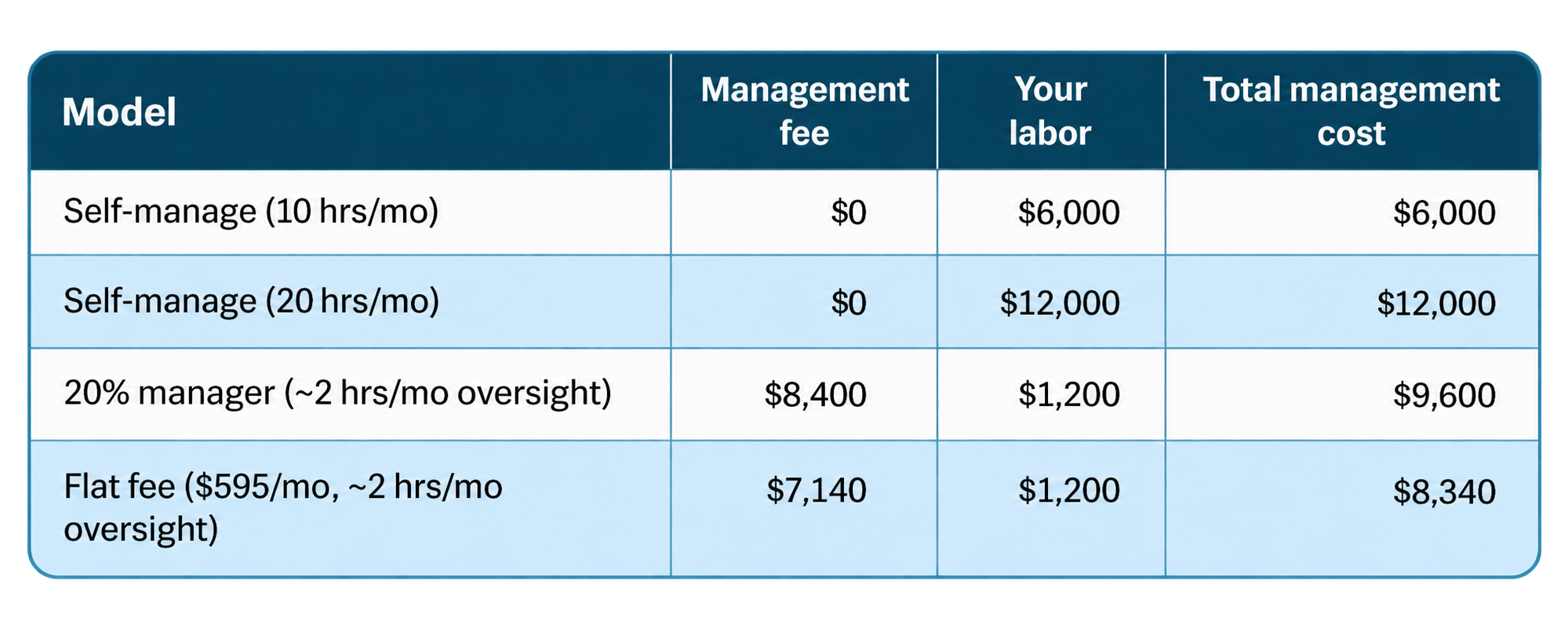
Self-managing is still the cheapest line at 10 hours a month, by a few thousand dollars. At 20 hours a month, it is the most expensive. And that is before counting lost bookings from static pricing or slow replies.
The question "is Airbnb property management worth it?" is really the question "what are my hours worth, and what else would I do with them?" If you would happily spend them hosting, self-management can make complete sense. If they are keeping you from your job, your family, or your next property, the rental has a cost even though no invoice ever arrives.
Why Austin Hosts Need to Run This Math Carefully

“Airbnb profits: It’s all about the right numbers.”
Two local factors change the equation for anyone comparing an Airbnb property manager Austin option against doing it themselves.
Compliance is now a revenue issue, not a paperwork issue. Austin requires a license for any rental under 30 consecutive days. Since July 1, 2026, booking platforms must display a city license number on every Austin listing and remove unlicensed listings within 10 days of a city request. Licenses run for two years. A self-manager who lets a renewal slip can lose the listing entirely during peak season.
Turnover execution has a wide quality range. Published Austin turnover prices span $75 to $275, and the cheapest quote is rarely the cheapest outcome. A short-term-rental turnover is not a residential house clean: it includes linen resets, restocking, damage checks, timing against checkout and check-in, and verification that the home is actually guest-ready. One missed clean before a check-in costs more than the difference between two quotes.
If you self-manage in Austin, your checklist includes license renewal timing, keeping the license number accurate on every platform, quarterly hotel occupancy tax reporting, and a turnover process with a backup cleaner. If you hire, confirm your manager handles each of those explicitly.
Should You Self-Manage or Hire Help?
There is no universal winner. Use this as the test:
Hire a manager when: revenue protected or created + value of your time recovered + operational risk reduced > total management cost
Self-managing makes sense when you enjoy hospitality, live close enough to solve problems in person, already have a reliable cleaner and handyman, understand dynamic pricing, and want control over every decision. It is strongest on a lower-revenue property, where a percentage manager would not cost much anyway and a flat fee would eat a large share of income.
Self-managing stops making sense when the rental starts dictating your schedule. A guest locked out at midnight. A cleaner canceling mid-turnover. An HVAC failure in August. A pricing calendar untouched through a sold-out weekend. A second property that doubles every workflow. These are not edge cases in short-term rentals; they are the job.
Before signing with any manager, ask six questions:
What exactly is included? Guest support, pricing, listing optimization, cleaning coordination, inspections, maintenance, reviews, compliance?
What is billed separately? Onboarding, photography, software, linens, supplies, emergency dispatch, termination.
Are vendor bills marked up? Get the percentage in writing.
Who owns the listing and reviews? If the answer is "we do," leaving will cost you your ranking history.
What happens to the fee when revenue doubles? A 25% manager costs $10,000 on $40,000 and $25,000 on $100,000.
What am I still responsible for? A low fee that leaves you coordinating vendors is not a low fee.
Where STR Management Co Fits
We built STR Management Co around the gap in that comparison: the host who does not want to hand over 20%–30% of growing revenue but also does not want to answer messages and chase cleaners forever.
Our model is a flat $595 per month per property, plus a one-time $595 onboarding fee, month-to-month with no long-term contract. It is white-label, so you keep your listings, reviews, platform accounts, and payouts under your own name while we run operations behind the scenes: 24/7 human guest support, dynamic pricing, cleaning and inspection scheduling with photo or video verification, maintenance and vendor coordination at cost with no markup, multi-platform distribution, listing updates, review and dispute support, and STR regulation and permit guidance. You can keep your preferred cleaning team or use ours.
For scale, one Austin client property on our site produced $87,000 in annual revenue at $595 a month, an effective management rate of about 8%. A 20% manager would have charged $17,400 for the same year.
We are not trying to convince every host that self-managing is wrong. Plenty of owners are excellent self-managers. The goal is to make sure you know what self-management is actually costing you, and to give you an option that does not scale its fee with your success when you decide your time is worth more elsewhere.
Run the Numbers on Your Property
Take your last 12 months of booking revenue, estimate your monthly hours, and fill in the table above with your own figures. If self-managing still wins, keep doing it. If it does not, or if the hours are the problem rather than the fee, that is what the call is for.
Book a free call with STR Management Co and we will run the comparison for your property with you: current fees, vendor markups, software, your time, and what a flat-fee model would leave you with.
