
How Seasonality Affects Airbnb Income in Austin

“Austin’s Airbnb market changes with the seasons — from spring travel and summer river days to fall festivals and winter getaways. Understanding these seasonal demand shifts helps hosts price smarter, plan ahead, and maximize income year-round.”
In Austin, the gap between your strongest booking month and your weakest can run close to 70% in revenue. Price your listing the same in January as you do in March, and you're simply handing that difference away.
That's the heart of how seasonality affects Airbnb income in Austin: this isn't a beach town with one obvious summer peak. It's an event-driven city where festivals, motorsports, and University of Texas football pull demand up and down all year long. March is the strongest revenue month. October is the strongest occupancy month. January is the weakest. Your pricing and your operations have to move with that calendar — or your profit won't.
What Austin hosts need to know
Austin is event-driven, not season-driven. March maximizes nightly rate, October maximizes occupancy, and January is the revenue low point.
The off-season is expensive. Peak months (March, October, November) average about $4,800/month versus $3,316/month in the low season (January, February, December) — roughly 45% higher. Compare the single best month to the single worst and the gap widens to about 69%.
Lead times flip by season. Guests book October stays about 68 days out; January stays only 28 days out. Open your fall calendar early.
Slow season is a conversion problem, not a discount problem. Shorter minimum stays, a leaner fee structure, and a sharper listing beat panic discounting.
2026 changed the math. A shorter SXSW, a closed convention center, and new STR license enforcement starting July 1 all reward organized operators.
Austin doesn't have a busy season — it has a rate season and an occupancy season
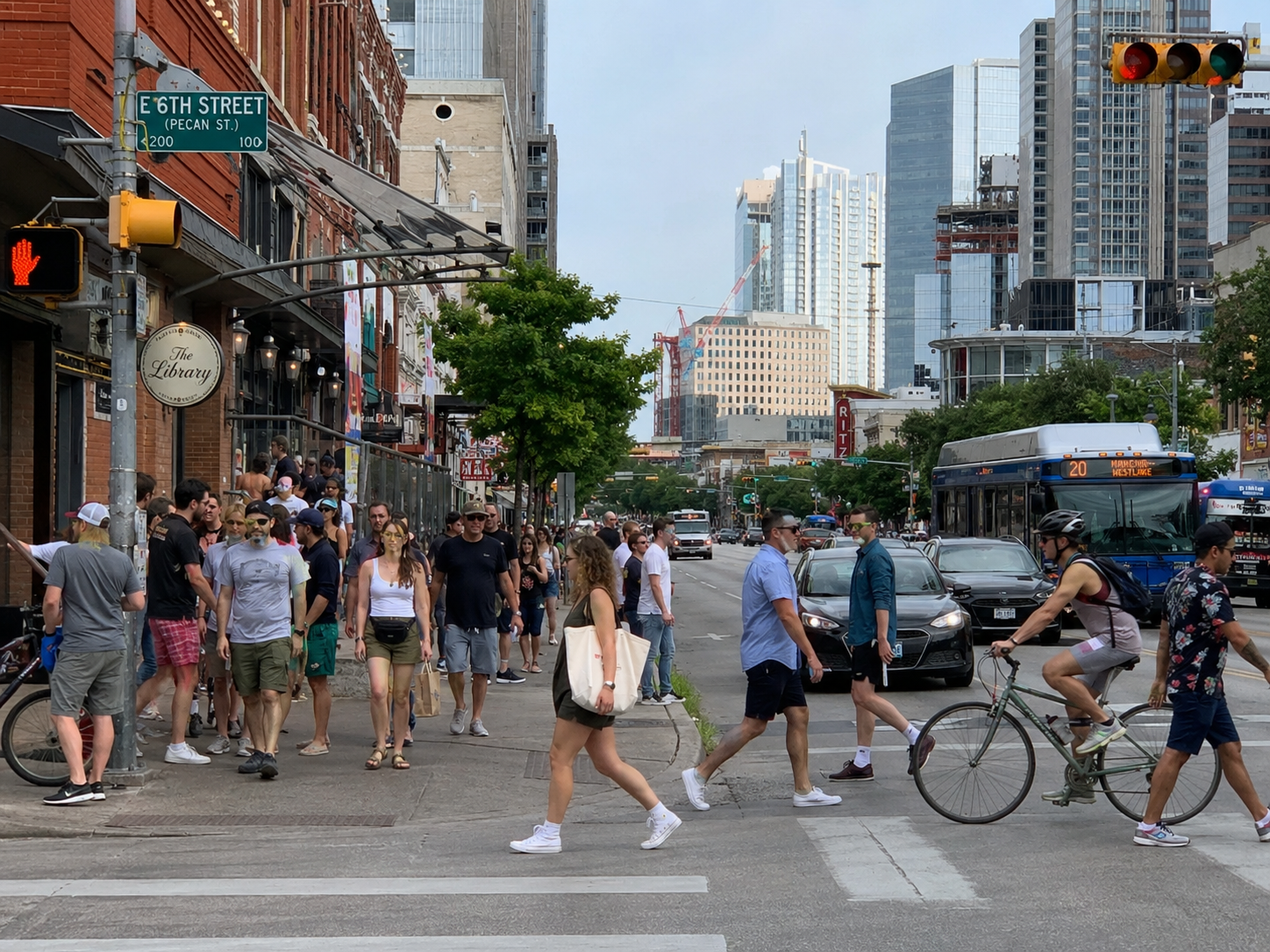
“Austin doesn’t have a busy season — it has rate seasons and occupancy seasons. The winners know the difference.”
The most useful way to read the Austin market isn't "busy versus slow." It's "rate-heavy versus occupancy-heavy," because the city monetizes different seasons in completely different ways.
AirROI's 2026 Austin dataset shows March as the peak revenue month, October as the peak occupancy month, April as the lowest-occupancy month, and July as the lowest-ADR month. That split matters. Spring can justify sharp rate increases, while fall rewards earlier calendar control and more deliberate compression management. Treat those two windows the same way and you'll overprice one and underbook the other.
The market is also big enough that execution decides who wins. Austin has roughly 8,007 active listings, with about 41.1% average occupancy, a $288 ADR, and $116 RevPAR. Revenue grew 6.4% year over year even as supply expanded a striking 56.8%. Translation: the market is crowded, but it isn't tapped out. Homes with strong pricing, strong reviews, and reliable operations still pull ahead.
What the off-season actually costs you
When hosts ask about occupancy rates by month in Austin, what they really want to know is where the income swings happen. Here's the clearest version of the answer.
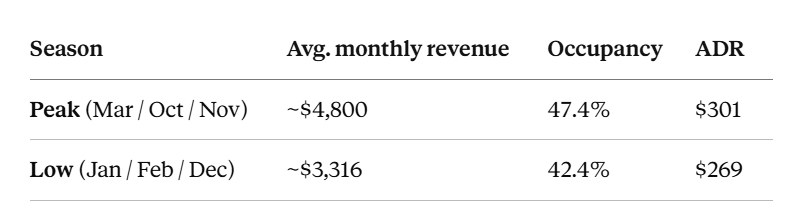
AirROI groups March, October, and November as Austin's peak season and January, February, and December as its low season.
Peak-season monthly revenue runs about 45% higher than low-season revenue. At the single-month extreme — your best month against your worst — the gap stretches to roughly 69%. That's the number that should change how you price. The market itself is telling you that one flat rate for the whole year is the wrong strategy.
The events that move Austin's calendar
Austin's seasonality is driven by its event calendar at least as much as by weather. Two clusters do most of the heavy lifting.
Spring (February–March) is a wall of demand. The Austin Marathon (nearly 20,000 runners), the ATX Open, NASCAR at COTA, SXSW, Rodeo Austin, and MotoGP at COTA all land within a few weeks. That stack is why March can be the strongest revenue month before summer leisure travel even begins — and it pushes spillover demand into neighborhoods well outside the downtown core.
Fall (October–November) is the other money window. October alone brings Austin City Limits across two weekends and the Formula 1 U.S. Grand Prix later in the month, then the Austin Film Festival rolls into early November. Add UT home football weekends and you get one of the longest sustained booking windows of the year.
The travel data backs this up. Austin-Bergstrom's October 2025 became the busiest month in airport history (about 2.09 million passengers), and the airport's single-day departure record came the Monday after the F1 weekend. That's not Airbnb data directly, but it's a strong independent signal that the fall stack generates real volume.
Lead times tell the same story from the host's side: guests book October stays about 68 days in advance, versus just 28 days for January. Fall demand commits early, which is exactly why your fall calendar needs to be open and monitored months ahead.
What to do in Austin's slow season

“In Austin, slow season doesn’t mean no movement — it means occupancy season. Demand may move slower, but smart "pricing keeps the calendar moving.”
So what about the slow season? In Austin, "slow" doesn't mean empty. It's mostly softer winter demand plus lower booking urgency outside the biggest event weekends. January is the lowest revenue month, with January, February, and December forming the weakest stretch — so winter is when you need a conversion strategy, not just optimism.
The instinct is to slash prices. Resist it. Most slow-season calendars don't need desperate discounting first; they need less friction. That usually means:
Shorter minimum stays on low-demand dates so you stop filtering out the bookings that do exist.
A leaner fee structure, because a bloated cleaning fee makes a two-night winter stay nearly impossible to convert.
Stronger listing copy and sharper lead photos, since winter shoppers compare more carefully.
Weekly discounts, which are especially effective in Austin where the average stay runs about 6.7 nights.
Cleaning economics deserve a hard look here. About 87.6% of Austin listings charge a cleaning fee, the median is $135, and fees average around 10.5% of gross revenue. If your fee sits well above the market, short stays get harder to win. If your turnovers are inconsistent, your reviews slip and your low-season ranking slides with them.
Summer has its own version of softness. Visit Austin still programs plenty in June and July — concert series, July 4th events, watch parties — but Austin's normal highs sit above 90°F from late May into late September, peaking in the upper 90s in August. July is the lowest-ADR month of the year. Summer demand is real, but guests skew more price-sensitive, more weekend-biased, and more likely to compare total trip cost. Price summer as a split market, not a dead one.
A seasonal dynamic-pricing playbook for Austin
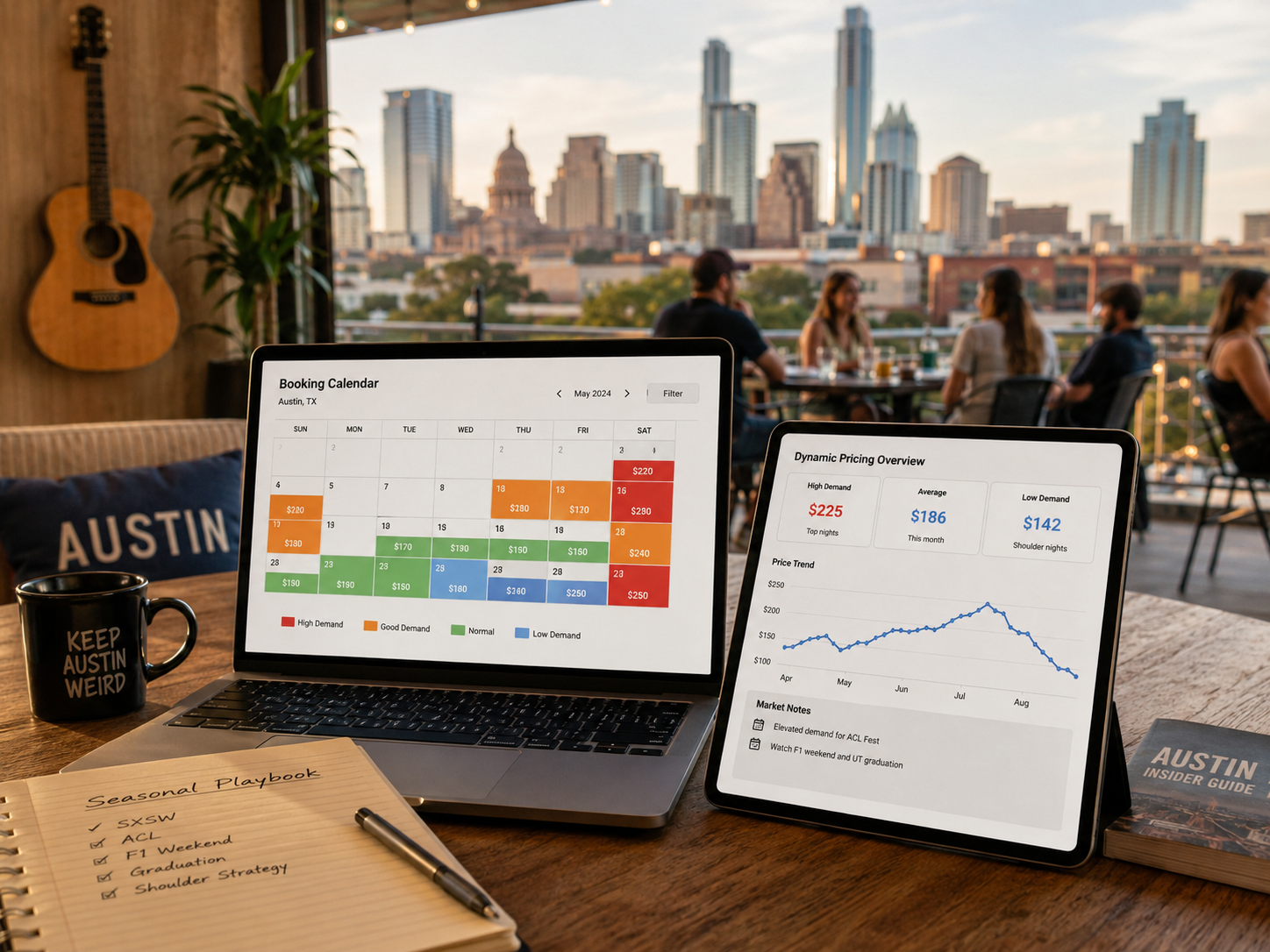
“Austin seasonality is never one-size-fits-all. A smart dynamic-pricing playbook knows when to push rates, when to protect occupancy, and how to adjust before demand shifts.”
A real dynamic-pricing strategy for Austin has to do three jobs at once: maximize compression in March and October, protect occupancy in the soft windows, and stop you from overpricing the wrong dates just because you know a citywide event exists nearby.
Here's a practical month-by-month frame:
Open fall calendars early and price them firmly — October guests commit roughly 68 days out, so late-opening calendars miss the highest-intent bookings.
Tighten rate and minimum stays around known compression weekends (SXSW, ACL, F1, UT home games), but verify your property is actually in the demand zone before assuming a premium.
Stay flexible in winter. January bookings come in shorter-lead and more price-sensitive, so favor occupancy protection over rate.
Treat summer as a split market, where weekend dates often hold rate better than midweek.
Your lead-time baseline — about 40 days overall, 68 in October, 28 in January — is the simplest signal for how far out to open and how aggressively to hold. Build your rules around it.
What changed in 2026 (and why it matters for your pricing)
Austin still has pricing power, but it's getting harder to wing it. Three 2026 shifts matter for your calendar.
First, SXSW ran on a shorter schedule, and local reporting tied that to roughly 20% fewer hotel rooms sold and weaker midweek spillover than hosts were used to in past years. March is still powerful — but don't assume "old SXSW behavior" repeats automatically.
Second, the Austin Convention Center is closed for redevelopment, with completion expected around 2028 and the reimagined facility slated for spring 2029. That removes a steady source of midweek and shoulder-season convention demand while it's offline.
Third, compliance enforcement tightened. The city hotel occupancy tax (HOT) is 11% and the state rate is 6%. Platforms have collected and remitted city HOT on qualifying bookings since April 1, 2025, but hosts still file quarterly reports. And beginning July 1, 2026, the city will begin requesting removal of unlicensed properties from STR platforms, which must
When it makes sense to bring in help

“A helping hand can lift more than a person—it can bring hope, strength, and a sense of care when it’s needed most.”
Austin's quality bar is already high. Listings average 4.84 out of 5, about 42.3% carry the Guest Favorite badge, and roughly 58.7% of hosts are Superhosts. You're not competing against sloppy inventory — you're competing against listings that are already polished.
That's why hiring help in Austin isn't really about saving time. It's about protecting revenue on your high-value dates and protecting review quality on your ordinary ones. If you can reprice quickly, confirm cleanings, manage guest messaging, and distribute across channels, you can monetize Austin's short, sharp demand windows far better than a host checking pricing tools once a week.
That's the gap STR Management Co is built to close. We run flat-fee, no-commission, month-to-month management — $595 per property per month, no long-term contract — covering 24/7 guest support, dynamic pricing, cleaning and quality-inspection scheduling, maintenance coordination, multi-platform distribution, listing optimization, review support, and compliance guidance.
The bottom line
Seasonality affects Airbnb income in Austin more than almost any other factor you control. The fix isn't one magic nightly rate — it's a seasonal playbook: event-aware pricing, calendar discipline, a smart fee structure, reliable cleaning, fast guest response, and compliance readiness, all adjusted by month.
Get that system right and Austin's swings become an advantage instead of a threat. Want help building one around your property, your neighborhood, and your goals? Book a call with us and we'll map a seasonal operating plan for the year ahead.
Frequently asked questions
What do Airbnb occupancy rates by month in Austin look like? Occupancy peaks around 47% in the fall (October leads the year) and dips to roughly 42% in winter. April is typically the lowest-occupancy month, even though spring is the highest for revenue, because March's high rates do the heavy lifting.
What are the best months for Airbnb bookings in Austin? March and October are the two strongest, driven by event clusters: SXSW and spring races in March, and ACL plus Formula 1 in October. February and November are strong shoulders.
Airbnb slow season in Austin — what should I do? Treat it as a conversion challenge. Shorten minimum stays, trim a bloated cleaning fee, refresh your listing photos and copy, and offer weekly discounts. Save deep nightly discounting for last.
How do I increase Airbnb bookings during the slow season in Austin? Reduce friction before you cut price: flexible minimums, competitive fees, stronger listing presentation, and promotions aimed at the guest type most likely to book that month.
What's the best dynamic-pricing strategy for Austin's seasons? Maximize rate in March, maximize occupancy in October, and stay flexible in January. Open fall calendars early, tighten around compression weekends, and price summer as a split weekend/midweek market.
How do I optimize Airbnb pricing seasonally in Austin? Anchor your rules to lead times — about 40 days on average, 68 in October, 28 in January — and adjust rate by month, day of week, and proximity to a real demand event.
