
How to Manage Multiple Airbnb Listings Without Burning Out

“Growth is exciting until every turnover feels urgent. A strong Airbnb operations system keeps things running smoothly.”
By your third listing, the spreadsheets stop working. Calendars drift out of sync. A cleaner shows up to the wrong unit. A guest's check-in message slips through the cracks at 11 pm. If you've felt this, you're not failing — you're hitting the wall every multi-property host hits.
The hosts who push through it aren't working harder. They're working through systems. This guide walks through how to manage multiple Airbnb listings efficiently — the tools, automations, checklists, and outsourcing decisions that turn a chaotic side hustle into a real business.
Run every listing through a single PMS or channel manager so calendars, rates, and messages stay in sync across Airbnb, Vrbo, and Booking.com.
Automate the three things that eat your day: guest messaging, cleaner scheduling, and lock codes.
Standardize operations with a per-property checklist so every turnover hits the same bar.
Outsource the rest. Co-hosts, cleaning teams, and maintenance vendors are how you scale past five or ten units.
Centralize Multiple Airbnb Listings in One Dashboard
The single highest-leverage move for managing multiple Airbnb properties is consolidating them into one dashboard. A property management system (PMS) or channel manager syncs calendars, rates, and guest messages across every platform you list on — so a booking on Vrbo instantly blocks the date on Airbnb and Booking.com.
Manually updating availability across three platforms is tolerable. Across ten, it's a guarantee of double bookings. The tools exist because the spreadsheet approach doesn't scale.
The category leaders worth evaluating:
Hospitable (formerly Smartbnb) — strong AI-powered messaging and review automation
Hostaway — robust for hosts running 5+ units with operational needs
Guesty — enterprise-grade, built for larger portfolios
Lodgify — all-in-one with a built-in direct-booking website
Smoobu, iGMS, OwnerRez — solid mid-tier options
What to look for: a unified inbox (one place for every guest message across every platform), automated calendar sync, and dynamic pricing integration. If a tool can't do those three things, keep looking.
Automate the Three Things That Eat Your Day
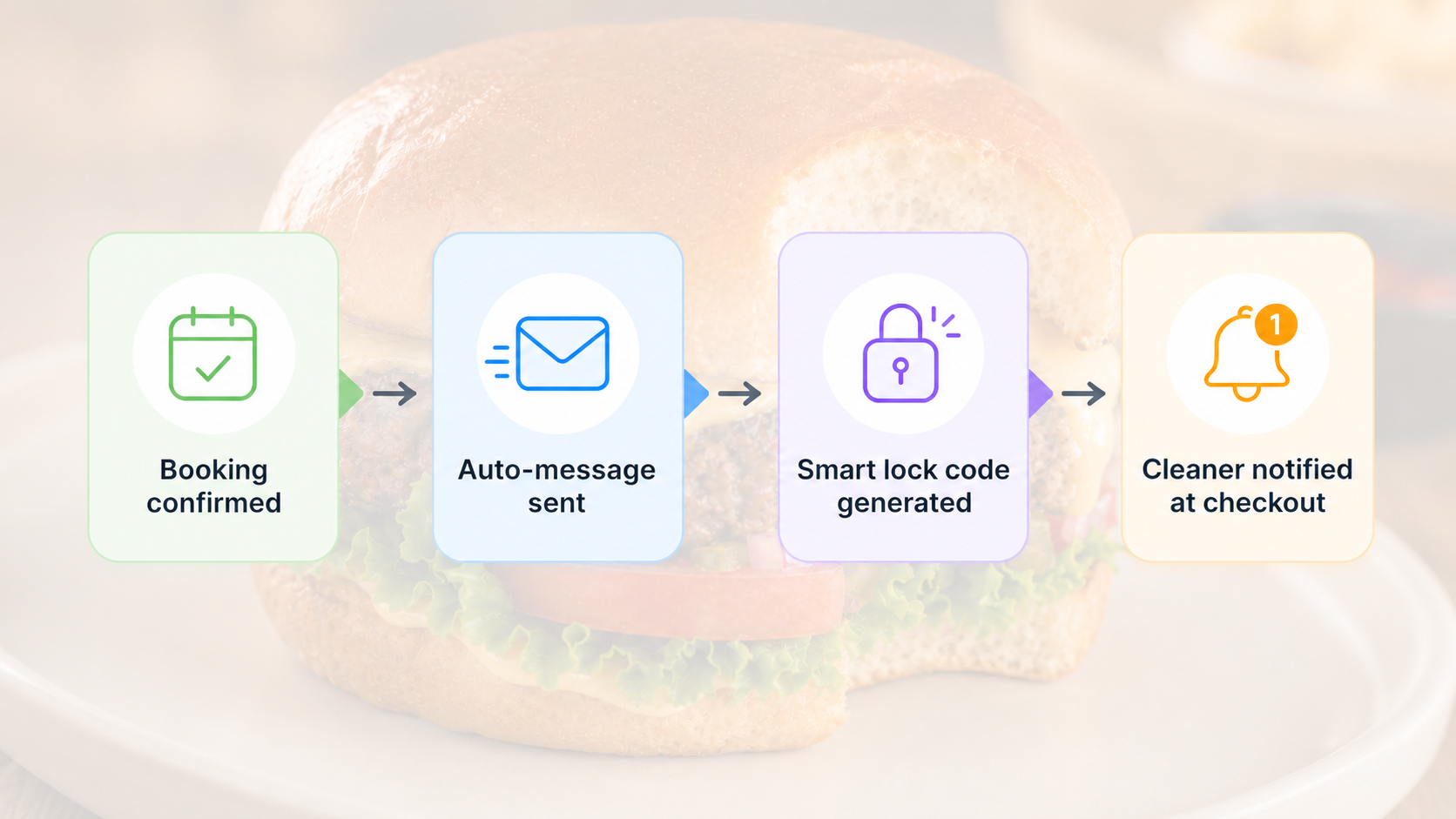
“Automate the three things that eat your day: guest messages, access codes, and turnover coordination — so you can manage more listings without managing more chaos.”
Most hosts lose time to the same three workflows: replying to guests, scheduling cleaners, and managing access codes. Each one can be automated to near-zero touch.
Guest Messaging
Set up automated sequences for the predictable touchpoints: booking confirmation, pre-arrival check-in instructions, mid-stay check-in, checkout reminder, and review request. Tools like Hospitable can also auto-answer the most common guest questions — Wi-Fi password, late checkout, parking — using AI trained on your listing details.
The non-negotiable: personalize templates with the guest's first name and a property-specific detail. Otherwise, automation reads as cold.
Cleaning and Turnovers
Connect your PMS to a cleaning tool like Turno or Properly. The moment a checkout is confirmed, your cleaner gets a notification with the turnover window, a photo checklist, and (with Turno) automatic payment on completion.
This is the single change that eliminates the most operational drama. No more 9pm group chats trying to figure out who's cleaning what tomorrow.
Smart Locks
Replace physical keys with smart locks — August, Schlage Encode, or RemoteLock all integrate with major PMS platforms. Each guest gets a unique code that activates at check-in and expires at checkout. Your cleaner has their own permanent code. You never coordinate a key handoff again.
Build a Repeatable Operations Checklist

“Five-star reviews don’t come from random one-off details. They come from boring, repeatable consistency — every unit running the same way, every time.”
Automation handles the routine; checklists protect against everything else. Every property in your portfolio should run on the same documented operating procedure, so quality doesn't degrade as you add units.
A solid Airbnb operations checklist for hosts covers:
Listing health: Photos refreshed yearly, description matches reality, pricing reviewed monthly, house rules current
Turnover cleaning: Room-by-room checklist with extra attention to kitchens, bathrooms, and high-touch surfaces; photo-verified by the cleaner
Restocking: Toilet paper, paper towels, coffee, soap, dish soap, trash bags — checked every turnover
Tech check: Wi-Fi working, smart TV logged out of the previous guest's accounts, smart lock battery level
Safety: Smoke and CO detectors tested quarterly, fire extinguisher in date, first-aid kit stocked
Guest comms: Welcome message sent 24 hours pre-arrival, thank-you and review request sent 24 hours post-checkout
Compliance: STR permit current, lodging tax filed, insurance verified
The point isn't the specific items — it's that every unit runs the same way, every time. Five-star reviews come from boring, repeatable consistency.
Scale by Co-Hosting and Outsourcing

“Scaling your Airbnb business doesn’t mean doing everything yourself. With co-hosting, outsourced cleaning, and organized turnover systems, you can manage more listings while keeping quality consistent.”
There's a ceiling to what one host can do solo, and it usually sits around five to eight properties. Past that, you either build a team or your nights and weekends disappear.
Two paths most hosts take:
Hire individual contractors. Cleaning team, handyman, virtual assistant for messaging. Cheaper per task, but you're still the operations manager — and you're the bottleneck when something breaks.
Bring in a co-host or short-term rental management company. They run the whole back end: guest support, calendar management, cleaner coordination, maintenance, restocks. You keep the listings in your name and stay the owner of record; they handle the day-to-day.
Traditional full-service property managers typically charge 20–25% of revenue. That math works at low occupancy but eats your margin when you're consistently booked. Flat-fee co-hosting models charge a monthly rate per property regardless of bookings — better economics for high-occupancy hosts.
If you're searching for Airbnb co-hosting services near you, ask any provider:
Is pricing flat-fee or percentage-based?
Do they handle 24/7 guest messaging in-house, or outsource it?
Are cleaning and maintenance vendors marked up, or passed through at cost?
Do you keep your listing in your own Airbnb account?
How STR Management Co. Fits In
We operate on the flat-fee co-hosting model — $595/month per property, no percentage, no markup on vendor work. From our base in Austin, TX, we handle messaging, calendar, pricing, cleaning coordination, and maintenance for hosts nationwide. Your listing stays in your account; we work in the background.
The Bottom Line
You can't manage multiple Airbnb listings the way you managed one. The mental load doesn't scale linearly — it compounds. Hosts who grow past the wall do three things: they centralize their tools, they automate the predictable workflows, and they outsource what's left.
Pick one section of this guide to act on this week. If your calendars aren't synced, start there. If you're still answering routine guest questions manually, start with messaging automation. Momentum matters more than perfection.
What's the biggest operational headache in your portfolio right now? Drop it in the comments — odds are other hosts are solving the same thing.
