
World Cup Airbnb Rates 2026: A Host's Pricing & Operations Playbook

“Cleanliness is your Airbnb’s home-field advantage.”
Searches for stays in 2026 World Cup host cities are up roughly 80% year-over-year, according to Airbnb's own booking data — and yet most early reservations are landing on listings priced under $500 a night. That contradiction is the entire story of World Cup Airbnb rates 2026. Hosts who treat the tournament like a blank check will price themselves into an empty calendar. Hosts who panic-discount the moment a few nights look soft will leave thousands of dollars on the table.
This is your host guide for the final stretch before the June 11 kickoff: how to price, when to hold the line, where to stay flexible, and what your operation has to look like when the world's biggest sporting event lands on your calendar.
World Cup Airbnb pricing in 90 seconds

“World Cup Airbnb pricing in 90 seconds: the clock is ticking—price smart before demand peaks.”
The tournament runs June 11 – July 19, 2026 across the U.S., Canada, and Mexico — 104 matches in 16 host cities, the first 48-team World Cup.
Search demand is up ~80% YoY, but guests are favoring listings under $500/night.
Group stage = gradual, broad demand. Knockout stage = compressed, late-booking, higher willingness to pay.
Anchor rates high, then adjust with intent. Discounting in May trains the market not to pay your June rate.
Non-U.S. travelers stay 13–16 nights on average — minimum-stay rules matter more than you think.
Austin is not a host city, but Texas hosts 16 matches (Dallas + Houston). Spillover demand is real but uneven.
Pricing is one piece. Cleaning, vendor backups, and 24/7 guest response decide whether occupancy converts to revenue — or to bad reviews.
The 2026 tournament in context
The 2026 FIFA World Cup is the largest in history. It runs from June 11 through July 19 across three countries and 16 host cities, with 104 matches and the first 48-team format. FIFA expects 6.5 million fans, and reported more than 500 million ticket requests in a single 33-day sales window.
That scale matters. But scale alone doesn't tell you how to price your listing. Guest behavior does — and the early signals are more interesting than the headlines suggest.
What 2026 World Cup Airbnb demand actually looks like
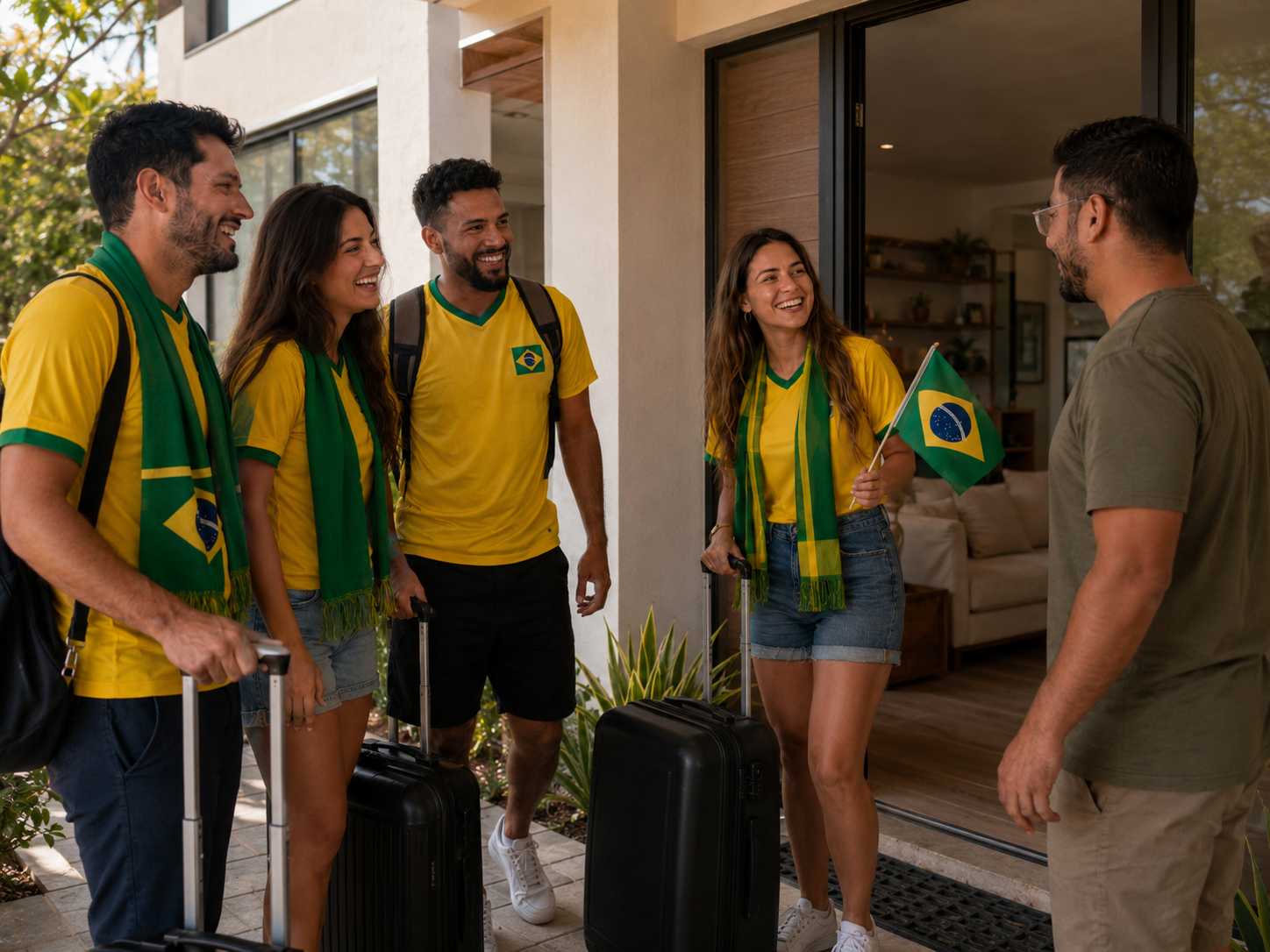
“World Cup trips feel even better when the whole team checks in under one roof.”
Demand is real, but uneven
A May hotel-market survey from the American Hotel & Lodging Association found that bookings in many U.S. host markets were tracking below early forecasts, and skewing more domestic than international. At the same time, revenue-management platform PriceLabs reports that every stadium market it analyzed is already showing higher ADR (average daily rate) and RevPAR than the same point in 2025 — even where occupancy isn't yet full.
Both can be true. Travelers are coming. They are just booking on a different curve than hosts expect, and revenue signals are showing up before calendars look "sold out."
Demand is group-heavy and trip-pattern-heavy
Airbnb says families and groups already account for more than half of World Cup trips. Two-night stays are most common among family bookings; four-to-five-night stays are next. And here is the number every host should write down:
Non-U.S. travelers represent 70% of tournament-driven gateway travel, and they stay an average of three nights longer than U.S. travelers — Latin and South American visitors average 16 nights, Europeans 14, Asia-Pacific 13
That single data point should reshape your minimum-stay strategy. If you optimize for quick weekend turns, you may miss the longest, most profitable bookings of the year.
What this means for your pricing assumption
Don't read an empty patch on your June calendar as evidence that your rates are too high. Tournament demand is lumpy by design — it clusters around specific matches, specific weekends, specific national teams, and listings that offer real value compared to two or three hotel rooms. Soft pacing in May does not predict soft pacing in June.
Airbnb pricing strategy for the World Cup 2026
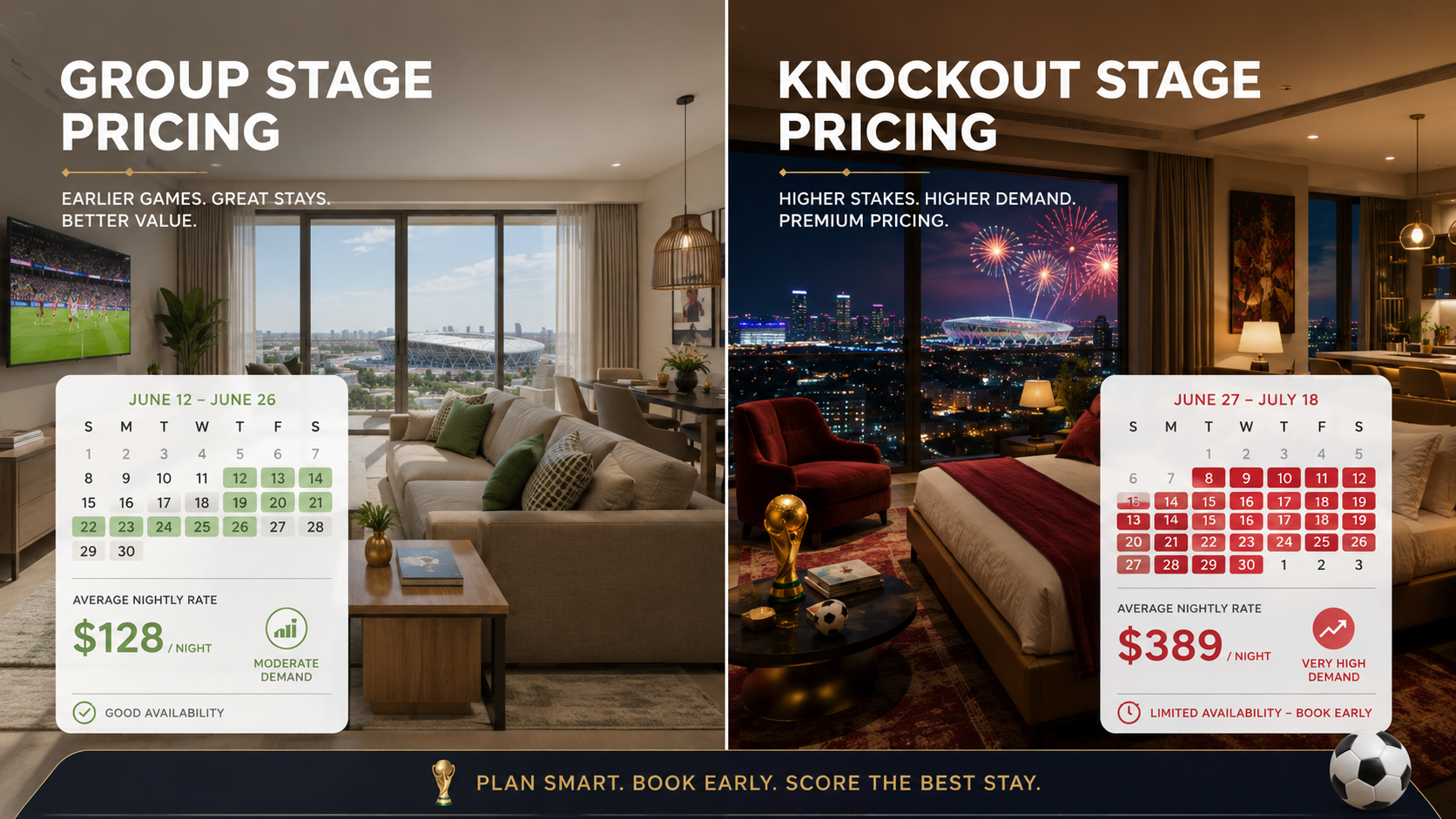
“Group stage fills the calendar. Knockout stage raises the rates.”
The core principle is simple: anchor high, then adjust with intent.
PriceLabs makes the case bluntly — every stadium market in its analysis is showing higher ADR than the comparable point in 2025, and hosts who let slow early pacing push them into premature discounts will train the market that their best dates are negotiable. Once a guest sees your June 14 night at $380, they will not pay $620 a week later, no matter what your competition is doing.
Group stage vs. knockout stage: price them as different products
How you price during the World Cup should change with the tournament phase, not just the calendar.
Group stage (June 11 – June 27) produces broader, more gradual demand. Matches are spread across cities. Every team is still alive, so fan travel is more distributed.
Knockout stage (June 29 onward) is compressed, last-minute, and has dramatically higher willingness to pay. Fans react to qualification news in real time.
Price Labs explicitly recommends raising rates immediately in stronger markets the moment a national team advances. That is the heart of Airbnb dynamic pricing for events: this is not a "set it and forget it" period. Group-stage nights and knockout-stage nights are different products and should be priced as different products.
Audit your discount stack before June
This is the silent revenue killer. Inside Airbnb, here is the override hierarchy you need to know:
Custom pricing overrides Smart Pricing on selected nights.
Discounts can push prices below your Smart Pricing minimum.
Weekly, monthly, and trip-length discounts override Smart Pricing.
Smart Pricing overrides rule-sets.
Early-bird discounts are not available when Smart Pricing is on.
Translation: an old 15% weekly discount or a forgotten last-minute promo can quietly undercut your strongest World Cup nights without you noticing. Open every pricing rule in your dashboard before June 1 and ask whether it should still be running during the tournament.
Price the total stay, not just the nightly number
Airbnb now displays total price (with fees, before taxes in most markets) directly in search worldwide. Guests see your full basket immediately. A "competitive" $400/night rate with a $250 cleaning fee on a two-night stay does not look competitive next to a $475/night listing with a $90 cleaning fee.
The best World Cup vacation rental rates are the ones that still look reasonable when the full price is exposed. Run the math from the guest's side of the screen.
World Cup Airbnb occupancy rates: what to expect
Occupancy is unlikely to move in a straight line — and that is normal. Group-stage demand often fills more gradually even when revenue-per-night is already outperforming last year. The temptation will be to cut rates when occupancy looks soft three weeks out. Resist it.
A short-term rental pricing strategy for 2026 should look like this:
Flexibility at the edges — keep shoulder nights bookable enough to avoid dead gaps that prevent longer stays from booking around them.
Discipline at the center — protect peak match windows with tighter trip-length minimums, stronger price floors, and no last-minute discounts.
Operational readiness — because high occupancy that turns into bad reviews is worse than moderate occupancy that gets five stars.
That last point is worth sitting with. When families and groups dominate a season, turnover quality, linen backups, inspection consistency, restocking, and response speed are revenue protection — not back-office concerns. A single missed restock or slow check-in message during the tournament will show up in your review score for the rest of the year.
Austin Airbnb property management for World Cup 2026

“The World Cup calendar is set—smart Airbnb hosts start planning before the dates fill up.”
Austin is not an official host city, and you should not market it as one. But ignoring the tournament if you host in Austin would be a real strategic mistake.
Texas is one of the tournament's most active corridors. Dallas hosts 9 matches. Houston hosts 7. That gives the state a significant share of all U.S. match inventory and creates genuine spillover potential — for road-tripping fans, longer multi-city itineraries, group stays, and team support staff moving between cities.
The case gets stronger with two specific signals:
Airbnb's data shows non-U.S. guests are driving most gateway travel beyond host cities themselves.
Saudi Arabia selected Austin as its base camp during the tournament. The team will reside and train there between group-stage matches, including one in Houston (announced via Austin FC).
That doesn't guarantee a surge for every Austin listing. It does mean demand will arrive in fragmented, less obvious waves — and the hosts who win in Austin will be the ones who:
Don't blindly copy host-city pricing.
Support shorter bookings cleanly and protect longer gateway stays profitably.
Position the listing as a polished Texas base — not a fake stadium-adjacent substitute.
Airbnb property management for the World Cup 2026
Here's the part most pricing guides skip: a great rate strategy fails if your operation can't deliver on it.
Airbnb property management during the World Cup means coordinating, simultaneously:
Guest messaging across more time zones than you usually serve
Cleaner schedules that bend around back-to-back two-night family stays
Vendor backups for the inevitable HVAC failure during a heatwave
Listing copy and photo updates that reflect tournament-relevant amenities (Wi-Fi speed, TV size, walkability, transit)
Review protection when guests are stressed, jet-lagged, and watching matches at 3 a.m.
Calendar strategy that adjusts as teams advance.
This is where STR Management Co operates. We charge a flat $595/month per property — no commissions, no hidden costs, no long-term contracts — and cover 24/7 guest support, dynamic pricing, vendor coordination, listing optimization across platforms, cleaning and quality-inspection scheduling, maintenance support, compliance guidance, and AI-based guest identity verification.
Hosts keep full control of their listings, reviews, platform accounts, and guest relationships under our white-label model. Onboarding takes three to five business days. We operate nationwide and currently manage 90+ properties generating more than $4M in annual booking revenue.
For owners who want Airbnb revenue management for the World Cup without giving up a percentage of gross revenue or losing their account ownership, that's a different commercial model than most agencies offer.
The bottom line on World Cup Airbnb rates 2026
The hosts who win this cycle will not be the ones who charge the most or the ones who discount the earliest. They will be the ones who price by tournament phase, audit their discount stack, set minimum stays for international guests, and keep their operation tight enough to convert peak occupancy into peak reviews.
If your June calendar already looks soft, the answer is almost never to drop your rate. The answer is to check your minimum-stay settings, review your discount overrides, tighten your photos and listing copy, and make sure your cleaning and guest-support coverage can handle compressed turnovers when knockout-round bookings start landing.
Your next step
If you're a host who wants pricing that moves with team progression, operations that hold up under pressure, and a clear flat-fee model with no commission cuts — book a 15-minute strategy call with STR Management Co before June. We'll review your current rates, your discount stack, and your operational gaps in one session.
What's your biggest concern about the tournament — pricing, operations, or guest mix? Drop it in the comments and we'll answer directly.
